
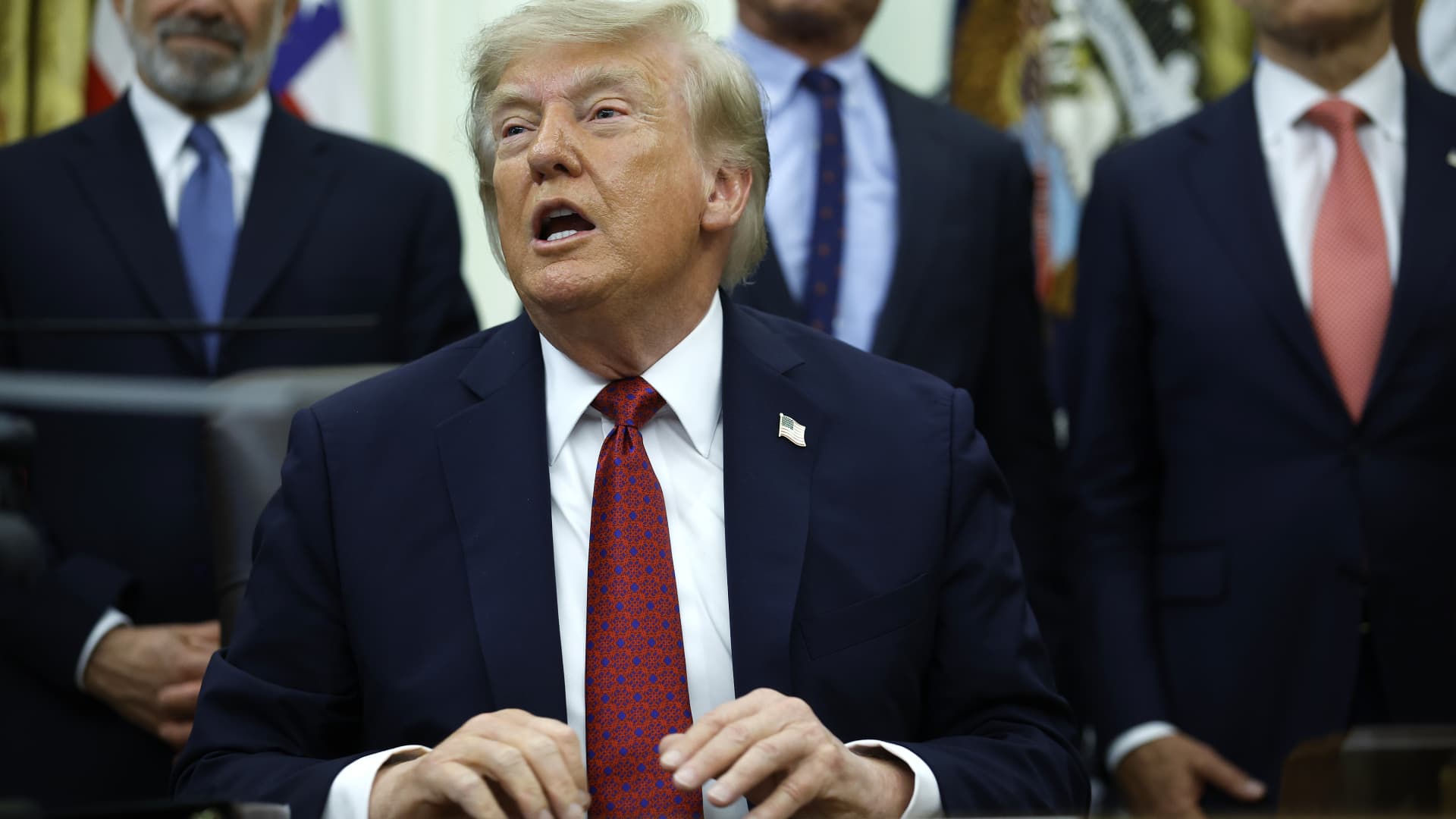

U.S. President Donald Trump speaks during a healthcare affordability event in the Oval Office at the White House on Aug. 31, 2026 in Washington, DC.
Kevin Dietsch | Getty Images
Hello, this is Hui Jie writing to you from Singapore. Welcome to another edition of CNBC’s Daily Open.
The Trump administration saw two embattled officials fending off criticism yesterday as the war in the Middle East flared up again, with U.S. President Donald Trump trying to lower pump prices and talk up growth.
Treasury Secretary Scott Bessent also defended the decision to increase bond purchases earlier last month, after investor Stanley Druckenmiller criticized the move.
If you were working late in Asia last night, you may not have caught any of this, simply because Microsoft Outlook and ChatGPT Work experienced outages. I know of more than a few office workers that were secretly grateful for the outage.
What you need to know today
U.S. President Donald Trump has unveiled a cunning plan to combat high pump prices for Americans, involving his claimed control over 65 billion barrels of oil reserves in Venezuela.
He will meet with U.S. refiners and fuel distributors, looking for ways to expand domestic refining capacity and bring down gasoline prices, according to a White House official.
Prices at U.S. pumps were at $4.08 per gallon on average nationwide Monday, according to AAA data, which is nearly 30% higher compared to the same time last year.
However, there is just one snag. Experts told CNBC that his deal with Venezuela will not lower gas prices anytime soon.
Venezuela’s oil infrastructure is in a state of disrepair, and it will require about $180 billion of investment till 2040 to return the country to peak production, according to Rystad Energy.
The South American nation is currently producing around 1.2 million barrels a day, down from a peak of 3.5 million bpd in the late 1990s.
Trump also has one eye on the Middle East, vowing to hit Iran “hard” after the Islamic Republic said it launched an attack on two U.S. bases in Jordan.
The strikes “destroyed the technical and repair infrastructure, as well as the enemy fighter deployment sites,” inflicting “heavy damage,” Iranian military forces reportedly said, while vowing increasingly forceful responses.
Growth and the Fed
Trump also continued his push for the Fed to lower interest rates, arguing that the U.S. could grow at rates of up to 20% (yes, that is not a typo), and adding such rapid growth should not prompt the central bank to raise interest rates.
“Success in growth does not cause inflation,” the U.S. president said. However, growth has never reached anywhere close to the levels Trump is saying, except for one Covid pandemic-related surge of 34.9% in 2020, which notably followed a 28% contraction in the previous quarter.
The most recent GDP numbers, however, are a far cry from the 20% annualized growth touted. Real GDP increased at a 1.5% annualized rate in the second quarter of 2026, down from 2.1% in the…
Read More: Trump presses economic growth as Warsh eyes brakes
