
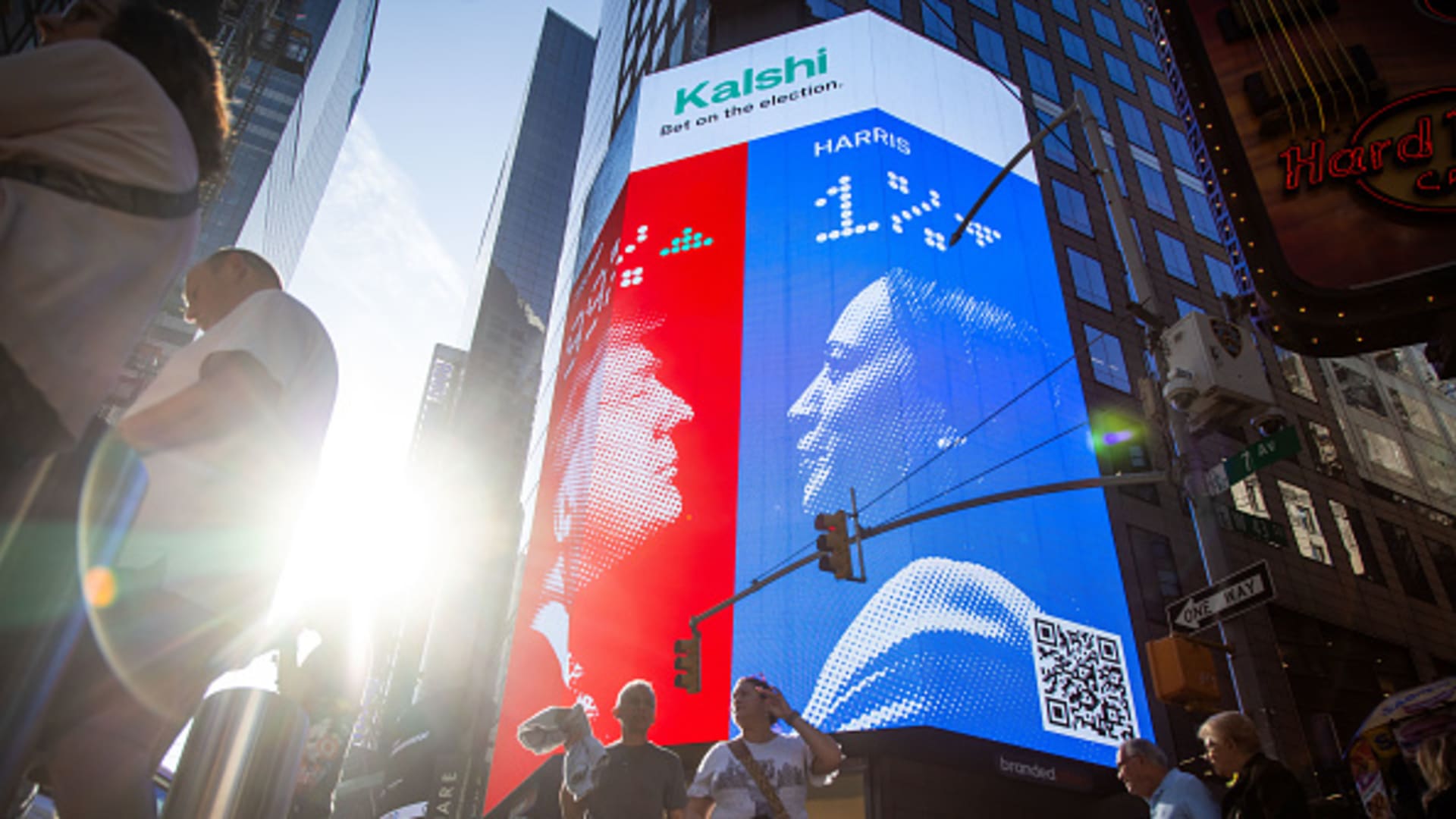

A billboard for Kalshi showing 2024 U.S. presidential election odds, across from the Nasdaq MarketSite in New York, Nov. 6, 2024.
Michael Nagle | Bloomberg | Getty Images
Prediction market platform Kalshi on Wednesday launched a new hub that allows political junkies to see how traders in many event contracts think the midterm elections will play out.
Kalshi’s “Midterms Hub” lets observers see what outcomes speculators expect in individual U.S. Senate and House of Representatives races, based on the latest odds for each market and across a map of the entire country.
The hub also features polling averages, so viewers can see how the prediction market odds compare with what statistical surveys of voters are showing; the latest Federal Election Commission fundraising reports for individual candidates; and curated news and analysis from various outlets, a Kalshi press release said.
The platform is aimed at those looking to Kalshi’s data for insights but not necessarily trade. Kalshi said that about three-quarters of all visitors to the platform don’t trade on contracts and only search to find current odds.
Tarek Mansour, co-founder and CEO of Kalshi, speaks on CNBC’s “Squawk Box” on June 24, 2026.
CNBC
In a statement, Kalshi CEO Tarek Mansour said prediction markets have a unique perspective, arguing they are hard to infiltrate with political bias.
“They cut through polarization and show you what the wisdom of the crowds actually believes, backed by real money, not rhetoric,” said Mansour, an MIT grad and one-time trader at Citadel and analyst at Goldman Sachs. “That kind of clarity is rare right now, and that’s what people are getting with the Midterms Hub.”
The launch of the political hub is the latest move by Kalshi to increase its political presence ahead of November’s midterm elections. In May, the platform introduced the “American Power Index,” what it called an “S&P 500” for politics, to track which political party is up and which is down.
It also comes as observers believe the midterm election season will likely lead to yet another spike in prediction market volume, as happened during the 2024 presidential election. More than $30 million has already been traded on contracts tied to which party will win the House and the Senate in 2026.

Read More: Kalshi launches election hub for prediction markets ahead of midterms
