
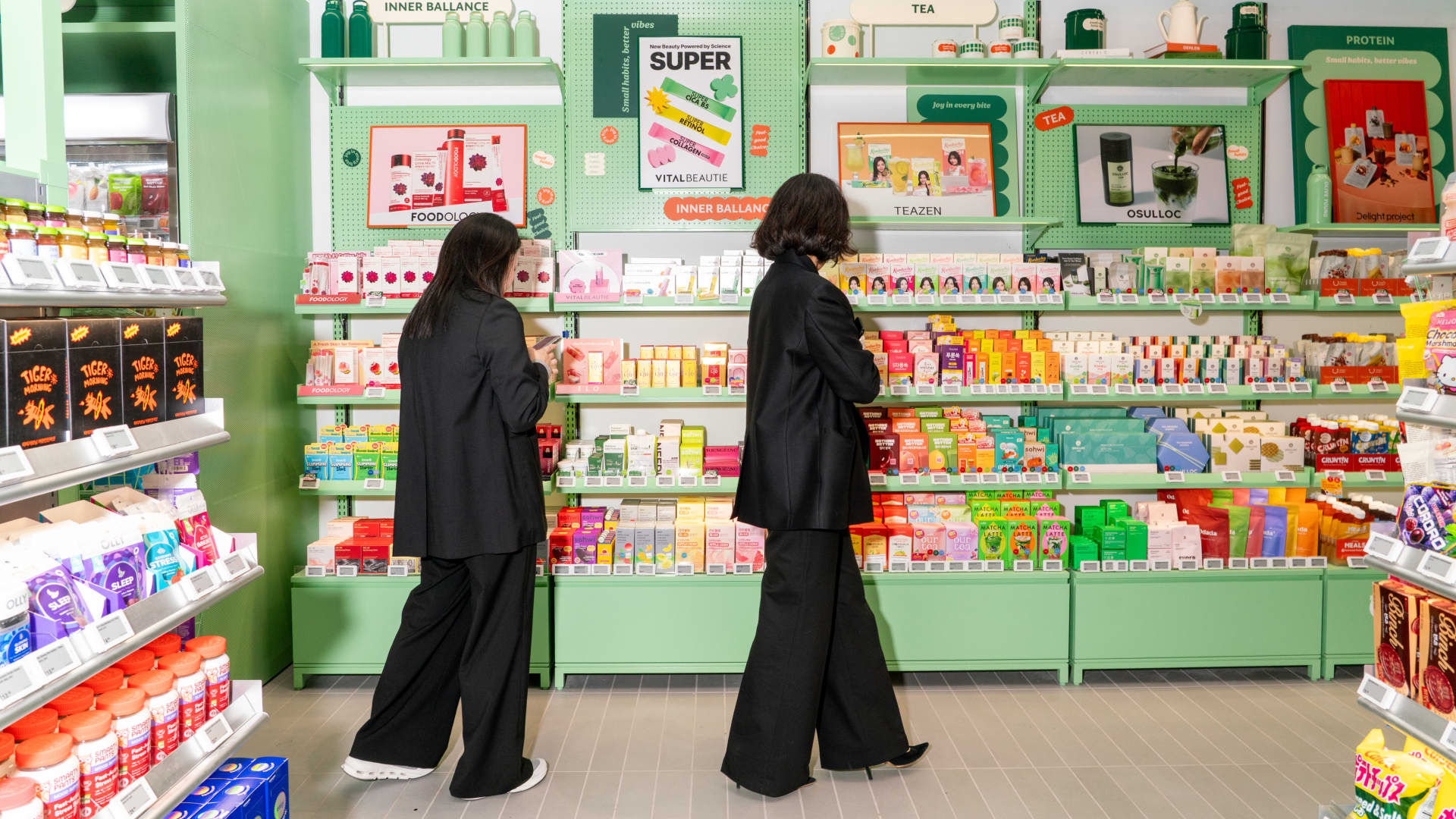

Shoppers during the grand opening of an Olive Young store in Pasadena, California, May 29, 2026.
Kyle Grillot | Bloomberg | Getty Images
When Olive Young opened its first U.S. outpost in late May, shoppers were already camping out, and the line spanned multiple blocks.
On opening weekend, the leading South Korean beauty retailer’s new store in Pasadena, California, had 6,000 customers move through its doors, and it currently sees an average of more than 1,600 visitors per day, the company said. It has since opened another location, in Century City, California, and said it plans to open more stores in the U.S.
Shoppers wait in line to enter the first U.S. location of Korean beauty retailer Olive Young during the store’s grand opening, in Pasadena, California, May 29, 2026.
Kyle Grillot | Bloomberg | Getty Images
That popularity is a microcosm of a bigger trend playing out in the U.S.: Consumers can’t get enough of beauty products from a country thousands of miles away — positioning some companies to get ahead.
“The U.S. is not only the world’s largest beauty market, but also one of the most influential in shaping global beauty trends, content, and consumer behavior,” Olive Young global communications lead Rena Kim said. “It was a natural and strategic next step in our global expansion.”
Glowing up
Consumption of Korean cosmetics, otherwise referred to as K-beauty, has been on the rise in the U.S. for years, with the “first wave” taking place in the 2010s and continuing into the Covid-19 pandemic.
“People were home. They had time to kind of learn about a 10-step skin care routine. They learned about what specific ingredients did, how to layer products together,” said Anna Mayo, a NielsenIQ beauty thought leader. “We saw the rise of this ‘glass skin’ look, and this real emphasis on healthy and glowing skin that looks great every day versus the need to kind of cover it up with cosmetics.”
“Consumers have already been primed in this skin care-first philosophy that they’re kind of living in,” she added.
Now, the “second wave” has taken hold, Mayo said, as K-beauty brands successfully take advantage of this appetite among U.S. consumers for skin care. According to NielsenIQ, U.S. K-beauty sales reached $2.8 billion in early 2026, representing a roughly 48% increase from a year ago. That’s faster than the nearly 45% growth rate seen in the prior-year period — an unusual acceleration, Mayo said.
K-beauty is also penetrating more U.S. households, climbing to 28.7% over the latest yearly period — a sign that it’s becoming stickier in the country.
Morgan Stanley analyst Simeon Gutman said he expects K-beauty’s growth trajectory to continue. In a note dated March 11, the analyst forecast that K-beauty sales in the U.S. can reach approximately $4 billion in 2026, citing “the rising popularity of K-culture and U.S. consumer demand for functional skincare products” as catalysts.
Gutman later confirmed to CNBC that those views are current.
Even if those projections…
Read More: Korean beauty products are becoming mainstream in the U.S.
