


Listen to this article
Estimated 5 minutes
The audio version of this article is generated by AI-based technology. Mispronunciations can occur. We are working with our partners to continually review and improve the results.
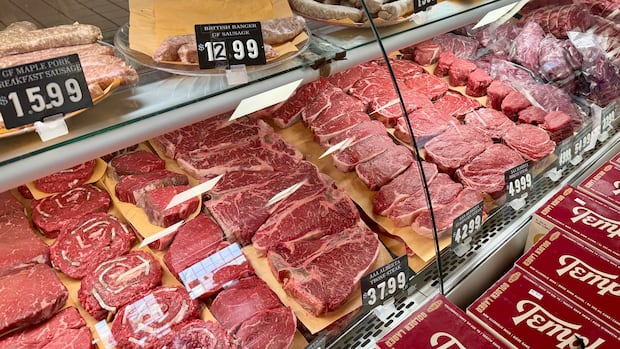
As Canadians fire up their barbecues this grilling season, many are finding steak and hamburger prices hard to swallow.
The cost of beef remains in record territory — up 62.6 per cent since 2021, according to Statistics Canada, driven by years of drought, shrinking cattle herds and rising production costs.
The latest Statistics Canada data in April shows beef prices rose 12.5 per cent over the last year. Prices peaked by 17.7 per cent in November 2025.
“I usually just buy hamburger and the odd time I’ll buy a steak,” said shopper Linda Brown in Calgary. “It still hurts to buy steak. It’s so darn expensive.”
Driving the increase in prices, industry experts say, is cattle supply, which remains tight after a series of droughts. But in spite of that, consumer appetite remains strong, with overall demand for beef at record levels.
“We’re not seeing a reduction in demand. People are still eating beef,” said Greg Keller, owner of Calgary’s Bon Ton Meat Market.
What’s to blame?
Industry analysts say current prices are the result of problems that began several years ago.
Severe drought conditions across Canada, the United States and Mexico in 2021 forced many ranchers to shrink their herds because of feed shortages and poor pasture conditions, said Brenna Grant, executive director of the Calgary-based beef statistics firm Canfax. Prices have steadily increased since then, with the Canadian beef herd at its lowest level in 40 years.
Now, there are early signs of recovery.

This year, the Canadian cattle herd recorded its first increase since 2018. According to Statistics Canada, the number of cattle and calves grew by 2.5 per cent to 11.1 million at the beginning of this year.
“Prices have rebounded to the point where it’s looking good to put cattle back into your cow herd,” said Kent Holowath with Two Valley Land and Cattle near Rumsey, Alta. He manages 175 cows.
Before the pandemic, a calf fetched $2.20 per pound, while today it is $7 per pound, according to Canfax data.
Holowath, who is also vice-president of Alberta Beef Producers, said he is trying to rebuild his own operation but rising costs are making expansion difficult.
“We’re like every other industry and household in the province where our costs have gone up,” said Holowath. “Our diesel fuel for spring seeding has gone up over 50, 60 per cent. Same with feeding cattle.”
However, you won’t immediately see relief at the grocery store, because it takes two to three years for animals to move through the system.
Different cuts of beef
Keller, at the Calgary meat market, said his customers still aren’t abstaining from…
Read More: Grilling pains: Why your BBQ may cost more this summer
