
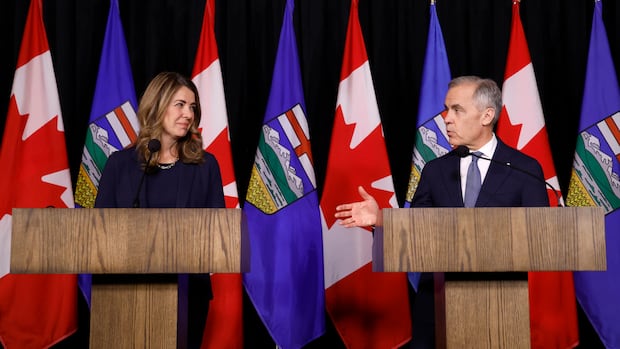

Now that Prime Minister Mark Carney and Alberta Premier Danielle Smith have signed a pivotal energy agreement that could usher in a new oil pipeline, representatives from both governments and industry are sharing their expectations on what comes next.
The agreement sets out a plan for Alberta to increase its effective industrial carbon emissions price in Alberta to $130 per tonne by 2040, and the headline price to $140 by that time. That’s up from its current price, which was frozen at $95 per tonne.
In exchange, Alberta will submit a proposal for a new oil pipeline to Carney’s Major Projects Office by July 1. The federal government says it will “pursue” to designate the pipeline as a project of national interest by Oct. 1.
In a Sunday morning interview on CBC’s Rosemary Barton Live, Intergovernmental Affairs Minister Dominic LeBlanc said the construction of a pipeline is “contingent” on going ahead with the Pathways project — a proposed carbon capture, utilization and storage project.
“These two projects, if ultimately they go ahead, would go ahead together,” LeBlanc told host Rosemary Barton. “We’ve been clear about that from the beginning.”

Chief political correspondent Rosemary Barton speaks with Adam Waterous, CEO of Strathcona Resources, to talk about what Ottawa’s announcements mean for the energy industry and the appetite for a new pipeline. And, Philippe Dunsky, president of Dunsky Energy + Climate Advisors and former chair of the Canada Electricity Advisory Council, about Ottawa’s plan to double Canada’s electricity grid and the challenges that stand in the way of the goal.
Alberta’s Social Services Minister Jason Nixon said he doesn’t believe the two projects have to move ahead at “exactly the same moment,” but noted there’s a commitment to “move forward with both of these phases of this agreement.”
“We’re hearing from industry that they believe they can accomplish [Pathways]. There’s obviously going to continue to be hurdles along the way as we make sure that we get this done,” Nixon told Barton in a separate interview.
If all goes to plan, the Alberta government has said design and construction of the pipeline “may commence as early as Sept. 1, 2027.” But significant variables remain, like buy-in from the B.C. government and B.C. First Nations.
B.C. Premier David Eby, who has been a vocal opponent of a new pipeline to the coast, said the federal government is “rewarding bad behaviour” in light of a potential secessionist referendum brewing in Alberta.
Plus, there’s the question of the business case.
Adam Waterous, executive chairman of Strathcona Resources, said he views the whole agreement as a mixture of good and bad news. While Ottawa is less resistant to a new pipeline, the raised carbon price is still a tough pill to swallow.
“That’s a pretty tough message to hear,…
Read More: PM Carney and Alberta’s Smith have signed a pivotal energy agreement. What
