
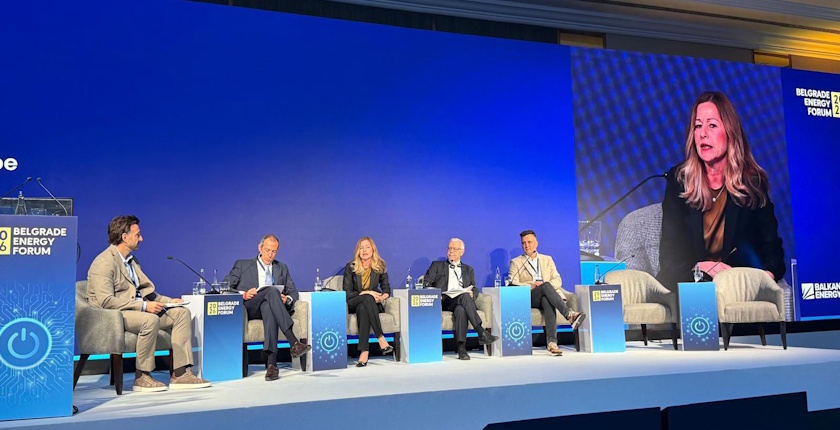

The introduction of the EU’s carbon border tax, uncertainties surrounding market coupling, and negative prices have brought about instability, which, amplified by ongoing wars, has fundamentally changed the environment for financing renewable energy projects, according to participants at Belgrade Energy Forum 2026 (BEF 2026). Still, representatives of international financial institutions, commercial banks, and investment funds advised conference participants to adapt to this volatility and prepare for a new phase in project financing.
All participants in the renewable energy market are facing a major shift in terms of financing, according to the moderator of a panel on financing, Marijan Rančić, Director of Business Development at New Energy Solutions.
“We started ten years ago with feed-in tariffs that ensured stable revenues and long-term offtake arrangements. Then we moved to auctions and merchant exposure risk. Now we are facing even greater challenges, such as negative prices, the impact of CBAM (the European Union’s Carbon Border Adjustment Mechanism – CBAM), and market coupling,” said Rančić at the opening of the panel, titled Emerging finance structures for the energy transition in Southeast Europe.
Panelists:
- Francesco Corbo, Regional Head of Energy for Western Balkans 6 and Croatia, EBRD
- Svetlana Cerović, Head of Financing, UniCredit Bank Serbia
- Reinhold Strauss, Board Member of the Green for Growth Fund (GGF)
- Vladimir Bogosavljević, Head of Business Development, MARSH
A new phase in the development of financing for green energy projects

Marijan Rančić, Francesco Corbo, and Svetlana Cerović (photo: Balkan Green Energy News)
The European Bank for Reconstruction and Development (EBRD) has been involved in all stages of the development of financial models in Serbia and the Western Balkans.
“The EBRD is here to de-risk investments and help create a market environment that is attractive to commercial banks and private investors. Our role is not primarily about volumes; our real measure of success is reaching the point where our support is no longer needed in the market,” said Francesco Corbo, Regional Head of Energy for the Western Balkans and Croatia at the EBRD.
“Back in 2017, the EBRD financed the first two renewable energy projects under Serbia’s feed-in tariff scheme. One of them was the Čibuk 1 wind farm, which remains the largest wind energy facility in Serbia. The project was financed together with UniCredit, Intesa, other private banks, and GGF,” he added.
It is encouraging that the Čibuk 2 wind project was fully financed by commercial banks
After that, there were several years without major investment in the energy sector, followed by COVID and the energy crisis. “As part of the liquidity loan provided to [Serbia’s state power utility] Elektroprivreda Srbije, we secured a commitment to organize three consecutive rounds of renewable energy auctions. The CfD scheme was launched in 2023, with projects…
Read More: Renewables financing environment completely reshaped by market instability
