
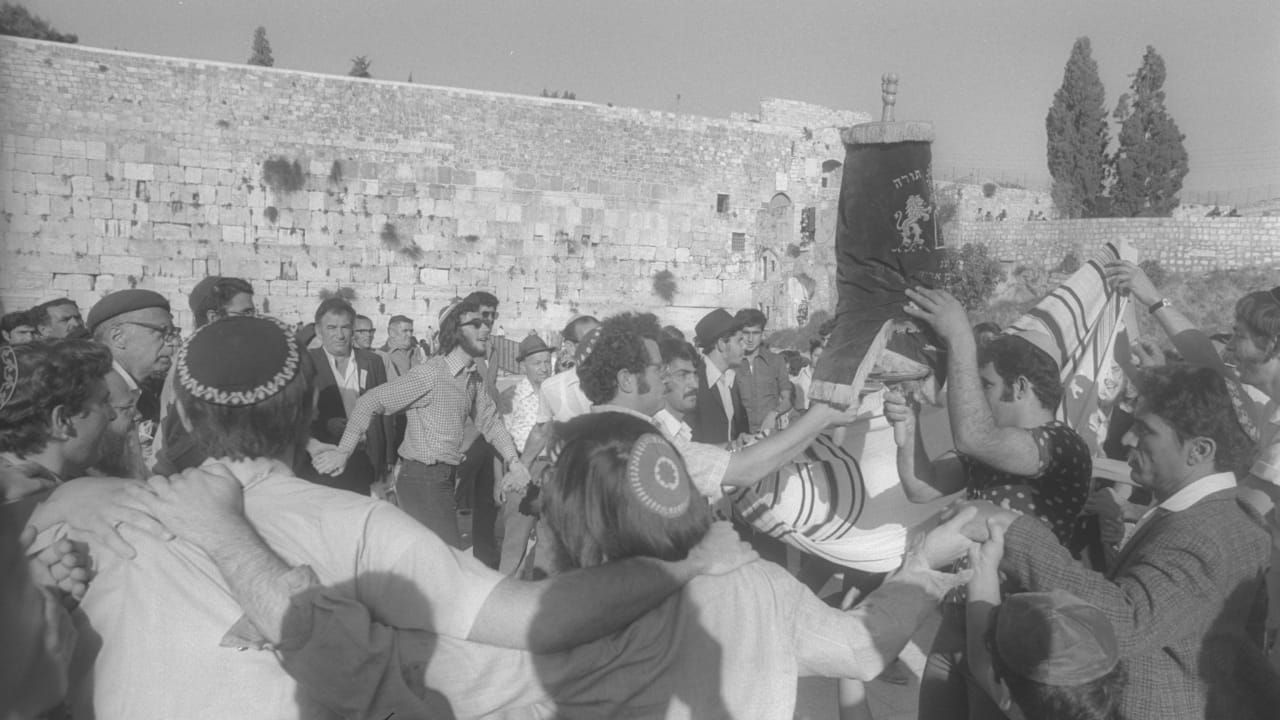

Jerusalem Day is one of my favorite days of the year, when we celebrate the reunification of Jerusalem. The highlight for me is the flag parade.
While some see this parade as a display of extreme nationalism, I think it’s beautiful. Seeing tens of thousands of our youth celebrating something of substance, in the era of social media and smartphones, is very moving.
After two and a half years of war, it takes on even more emotion, as I can’t help thinking about how many of our heroic soldiers who fell in battle were marching and waving flags in previous parades.
As I’ve written in the past, I’ll leave it to Rabbi Jonathan Sachs to describe the feeling: “On Yom Yerushalayim a few years ago, standing on the streets of the city, I watched youngsters from around the world waving Israeli flags, singing and dancing with a joy that was overwhelming. As I watched the celebrations, I was overcome with emotion because suddenly I had a vision of the 1.5 million children who were killed in the Shoah not because of anything they had done, not because of anything their parents had done, but because their grandparents happened to be Jews.
“I thought how some of the greatest empires the world has ever known – Egypt of the Pharaohs, Assyria, Babylon, the Alexandrian Empire, the Roman Empire, the medieval empires of Christianity and Islam all the way to the Third Reich and the Soviet Union – were the superpowers of their day that bestrode the narrow world like a colossus, seemingly invulnerable in their time. And yet each tried to write the obituary of the Jewish people, and whilst they have been consigned to history, our people can still stand and sing Am Yisrael Chai. What I was seeing on that day in Jerusalem was techiyat hamaytim, a collective people being brought back from death to life.”

Next week we celebrate Shavuot. Unity plays a central part of the festival. I’m not talking about how lasagna, cheesecake, and blintzes can be unified to create a delicious meal. Shavuot celebrates the Jewish people receiving the Torah. The unification of the Jewish people at Sinai allowed for the receiving of the Torah.
“And there Israel camped opposite the mountain” (Exodus 19:1-2). At all their other encampments, the verse says vayachanu (“and they camped,” in the plural); here it says vayichan (“and he camped,” in the singular). For all the other encampments were in argument and dissent, whereas here they camped as one human, with one heart (Mechilta, Rashi).
‘Kol yisrael areivim zeh bazeh’
An extension of unity is the concept of each person’s responsibility to take care of each other. This has many ramifications in Halacha. Rabbi Raphael Katz writes: “The Talmud in Shevuot 39a explains the verse ‘And a man will stumble because of his brother’s iniquity.’ This teaches ‘shekol yisrael areivim zeh…
Read More: Your Investments: Financial freedom and Jerusalem unification
