
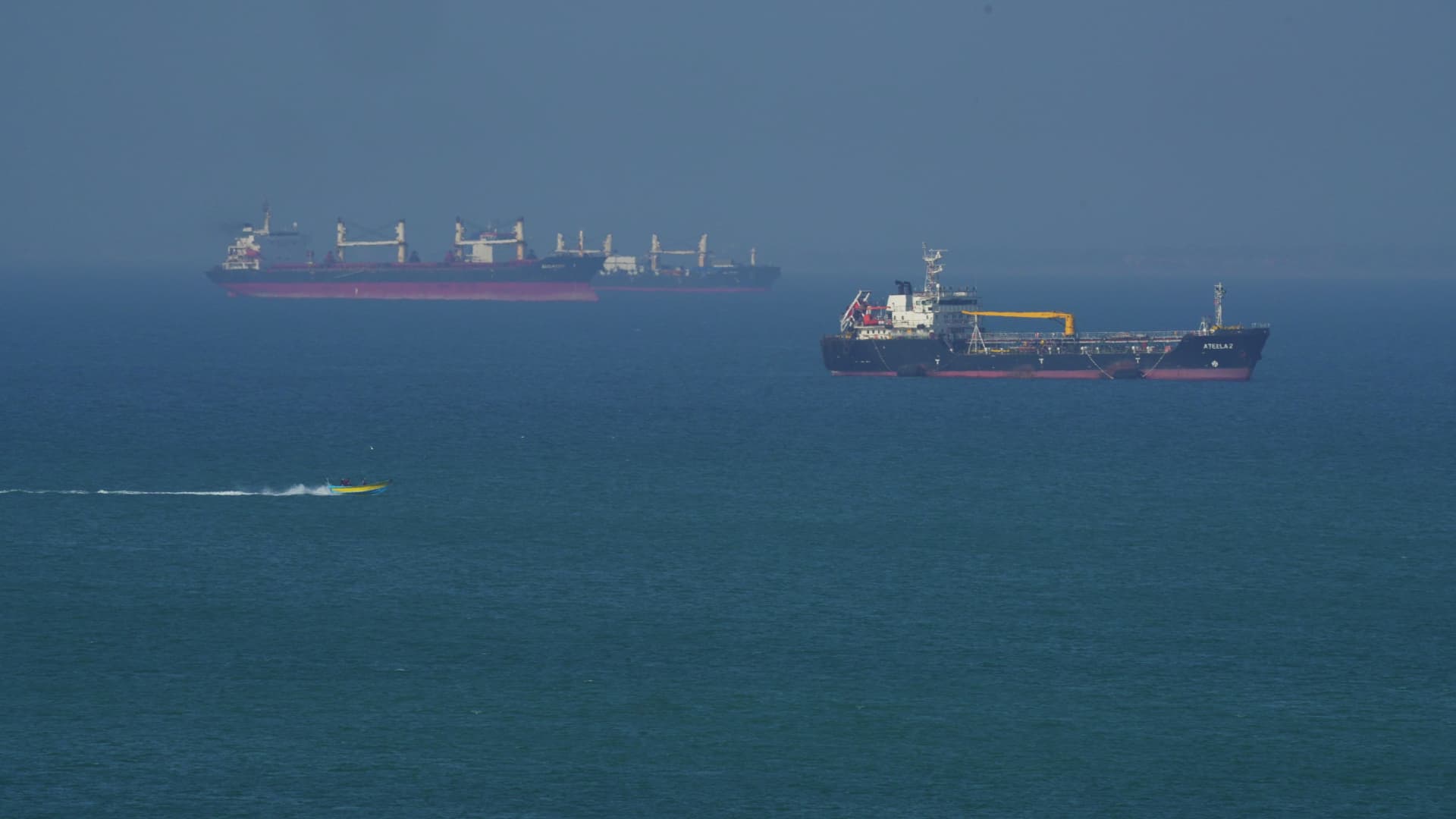


Oil prices hovered around $100 on Thursday, after the White House said President Donald Trump and President Xi Jinping agreed that the Strait of Hormuz must remain open.
International benchmark Brent crude futures for July were 58 cents lower at $105.05 a barrel by 9:36 a.m ET. U.S. West Texas Intermediate futures for June declined 46 cents at $100.56 per barrel.
“The two sides agreed that the Strait of Hormuz must remain open to support the free flow of energy,” a White House official said in a statement Thursday. “President Xi also made clear China’s opposition to the militarization of the Strait and any effort to charge a toll for its use.”
Xi also expressed interest in buying U.S. oil, the White House official said. However, Chinese state media did not mention any dicussion of Hormuz or oil purchases.
Trump and Xi “exchanged views on major international and regional issues, such as the Middle East situation,” according to state-owned Xinhua.
OPEC, IEA forecasts
OPEC and the International Energy Agency on Tuesday published their latest updates on how the Iran war has impacted the oil market.
OPEC cut its demand growth estimates for 2026 to about 1.2 million barrels per day, from 1.4 million bpd previously, in its latest monthly update. The cartel’s production fell by 1.7 million bpd in April and has declined more than 30%, or 9.7 million bpd since the start of the Iran war in late February.
OPEC’s latest update is expected to be the last one to include data from the United Arab Emirates, which exited the cartel on May 1.
“More than ten weeks after the war in the Middle East began, mounting supply losses from the Strait of Hormuz are depleting global oil inventories at a record pace,” the IEA said.
With more than 14 million bpd of supply cut, the overall loss from Gulf producers is now over a billion barrels, the IEA said, adding that greater price volatility is likely as peak summer demand approaches.
“The duration of elevated fuel prices remains a subject of intense discussion and is closely tied to ongoing geopolitical developments surrounding the closure of the Strait of Hormuz, as well as the potential damage to oil and gas infrastructure in the Middle East from further conflict,” ING analysts said in a note.
— CNBC’s Spencer Kimball contributed to this report.
Correction: This story has been updated to correct the day to Thursday.
Read More: Oil prices hover around $100 after White House says Trump and Xi discussed
