
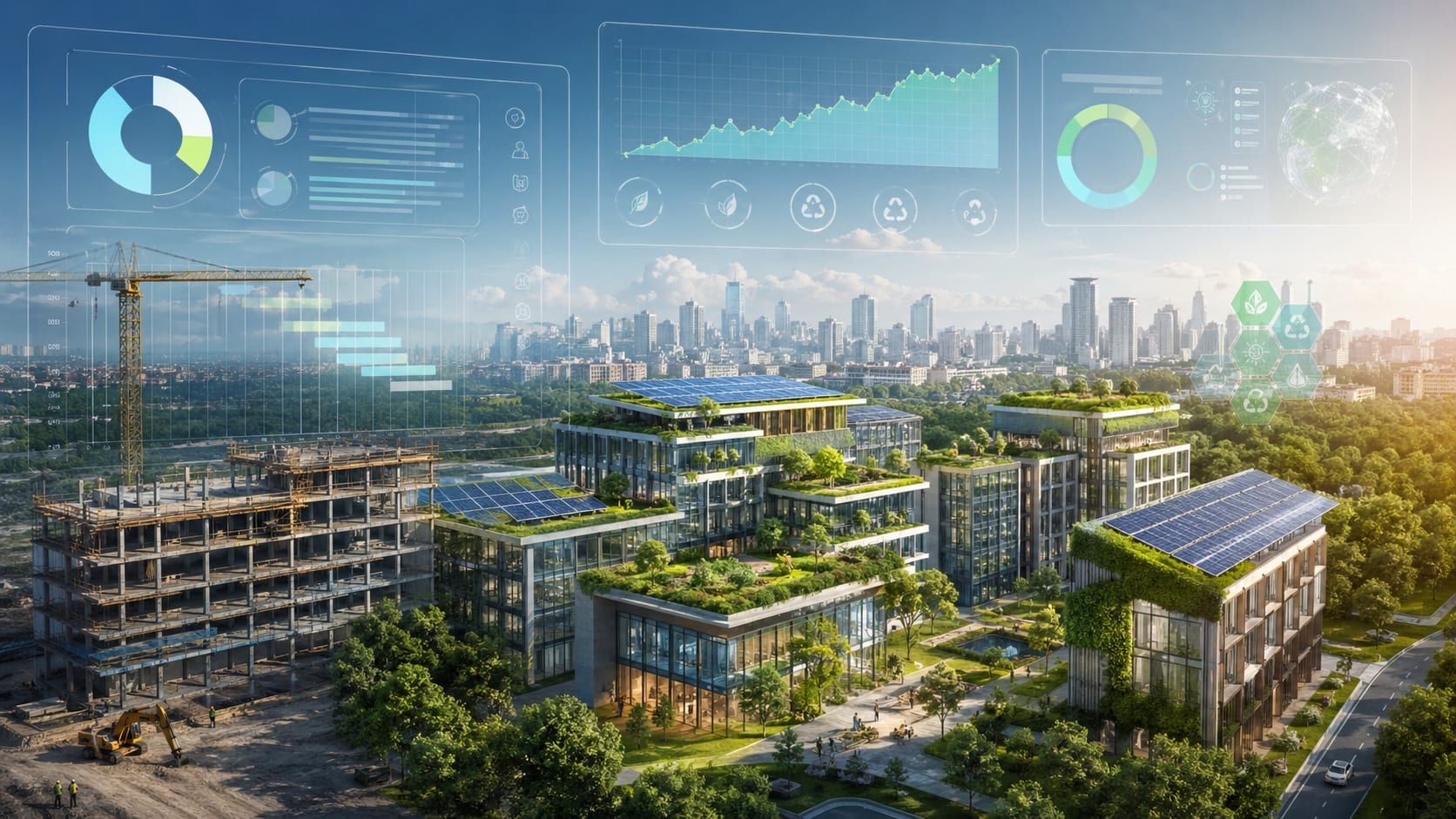

Sustainability in real estate is no longer handled as a parallel initiative. It is becoming embedded in how projects are planned, financed, executed, and managed. The shift is being driven by one key enabler – ERP systems for sustainable real estate.
By connecting procurement, operations, compliance, and financial data into a unified system, ERP platforms give decision-makers real-time visibility into carbon impact, energy use, and resource efficiency turning sustainability from a reporting task into a controllable process.
In this article, we explore how ERP systems are enabling sustainable real estate and accelerating net-zero construction.
Why is ERP Becoming Central to Sustainable Real Estate?
The biggest challenge in achieving net-zero construction is not a lack of intent—it’s a lack of connected data.
Traditionally, sustainability metrics existed in isolated spreadsheets or reporting tools. These reports were often disconnected from procurement decisions, construction planning, and operational workflows.
ERP systems solve this problem by acting as a central intelligence layer across the entire real estate lifecycle.
With the right ERP platform in place, organizations can:
- Track carbon emissions alongside project costs
- Align procurement with sustainability goals
- Monitor environmental performance across the entire asset lifecycle
- Automate ESG (Environmental, Social, and Governance) reporting
- Improve transparency for regulators, investors, and stakeholders
This is why ERP systems are increasingly viewed as core infrastructure for sustainable real estate development, rather than just back-office software.
How Do ERP Systems Support Net-Zero Construction?
Understanding how ERP systems support net-zero construction comes down to how effectively they connect environmental insights with everyday decisions.
1. Carbon Footprint Tracking
Modern ERP platforms integrate carbon accounting directly into workflows.
- Track emissions from material sourcing to project delivery
- Align reporting with global frameworks like the Greenhouse Gas Protocol and ISO (International Organization for Standardization) standards
- Identify high-impact areas early and take corrective action
This level of transparency makes sustainability measurable and manageable.
2. Waste & Resource Optimization
Construction waste remains a major inefficiency. ERP systems address this by tracking materials in real time.
- Prevent over-ordering through accurate demand planning
- Monitor usage vs. wastage at every stage
- Improve inventory efficiency across multiple sites
The result:- reduced material loss and tighter cost control.
3. Energy Efficiency Across Operations
ERP platforms allow teams to monitor energy consumption across projects and assets.
- Track equipment usage and idle time
- Identify energy-heavy operations
- Optimize machine scheduling and building performance
This directly supports the role of ERP in reducing carbon footprint in construction -…
Read More: How ERP Systems Are Enabling Sustainable Real Estate and Net-Zero
