
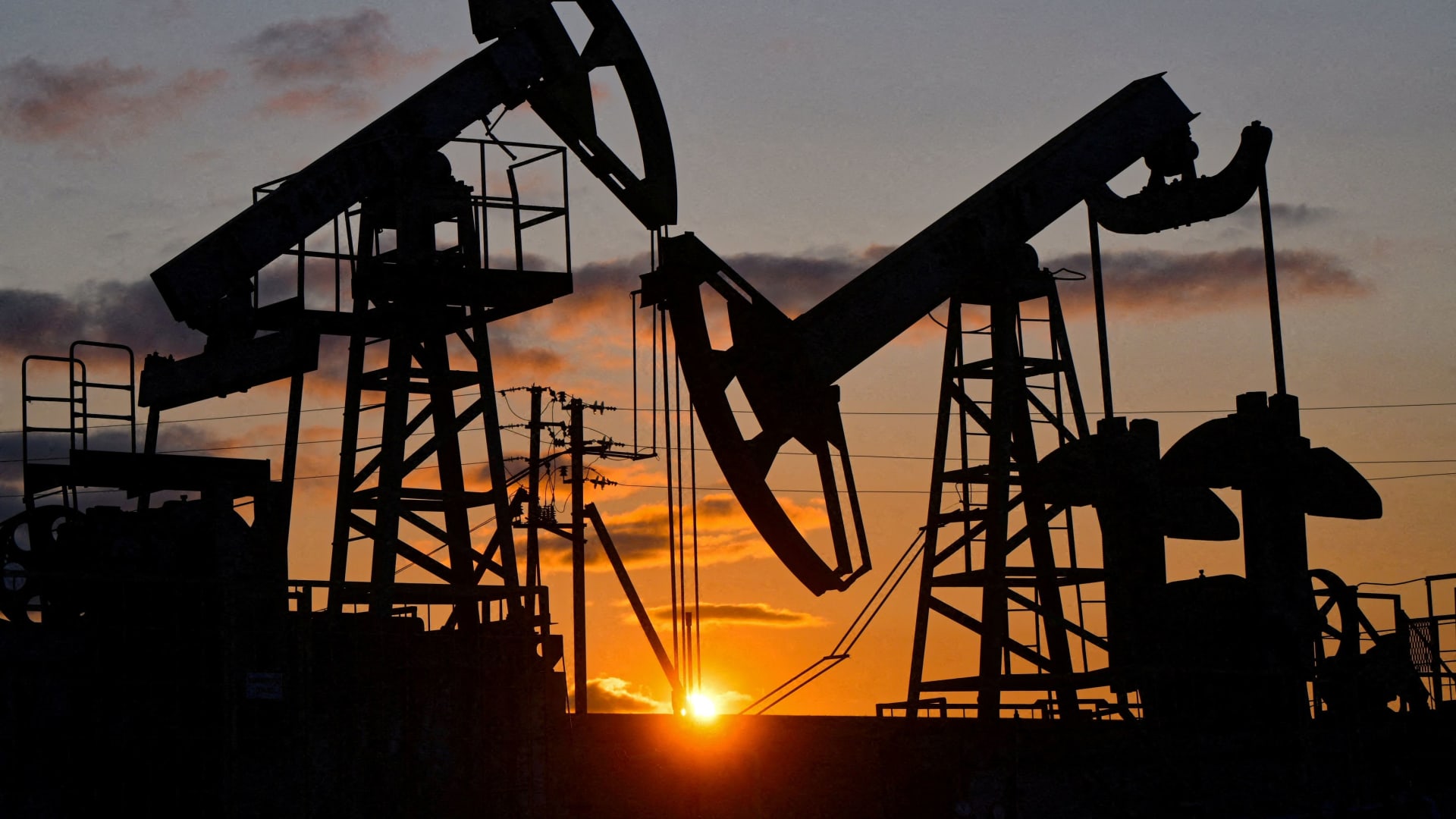

A view shows oil pump jacks outside Almetyevsk in the Republic of Tatarstan, Russia June 4, 2023.
Alexander Manzyuk | Reuters
Oil prices plunged Friday after Iran’s foreign minister declared the Strait of Hormuz “completely open” during the ceasefire between Israel and Lebanon, raising hopes the huge supply disruption will ease.
Foreign Minister Seyed Abbas Araghchi’s comments on X followed remarks by U.S. President Donald Trump, who said late Thursday that the war with Iran, which began on Feb. 28, “should be ending pretty soon.”
U.S. crude oil futures for May delivery fell nearly 12% to close at $83.85 per barrel. International benchmark Brent for June delivery lost 9% to settle at $90.38 per barrel.
In the social media post, Araghchi said vessels traveling through the critical waterway must sail a “coordinated route” prescribed by Iran’s maritime authorities.
Trump responded Friday in a Truth Social post by thanking Iran for opening the strait. He said, however, in a second social media post that a U.S. naval blockade of Iran’s ports will remain in “FULL FORCE” until the U.S. reaches a deal with Iran.
Israel and Lebanon agreed Thursday to a 10-day ceasefire that started at at 5 p.m. ET that evening. Israel has been striking Lebanon in a military campaign against Hezbollah, a militant group that is allied with Iran. The conflict between the groups has hampered U.S. negotiations with Iran.
Trump said in a Truth Social post that Israeli Prime Minister Benjamin Netanyahu and Lebanese President Joseph Aoun would be invited to the White House for what he described as the first meaningful talks between the two countries since 1983.

The U.S. State Department said both sides aimed to create conditions for lasting peace, including mutual recognition of sovereignty. The department said the effort included improved border security and reaffirmed Israel’s right to self-defense.
It also noted shared concerns over nonstate armed groups from undermining Lebanon’s sovereignty.
Trump said he expects Lebanon to “take care of Hezbollah.” The developments raised hopes of a broader resolution to the Middle East conflict.
Oil prices began drifting lower on expectations that the U.S. and Iran could extend their ceasefire by another two weeks and potentially resume talks to end the conflict, ING said.
“However, the physical market is becoming tighter every day that passes without a restart of oil flows through the Strait of Hormuz,” ING analysts said in a note.
Even accounting for pipeline rerouting and limited tanker movements, ING estimates roughly 13 million barrels per day of supply has been disrupted, a figure that could rise further under a U.S. blockade.
“The key upside risk for the market is that peace talks between the US and Iran break down. This isn’t an unrealistic scenario, given that US and Iranian demands remain fairly wide apart.”
Read More: Oil tumbles more than 10% as Iran declares Strait of Hormuz open
