


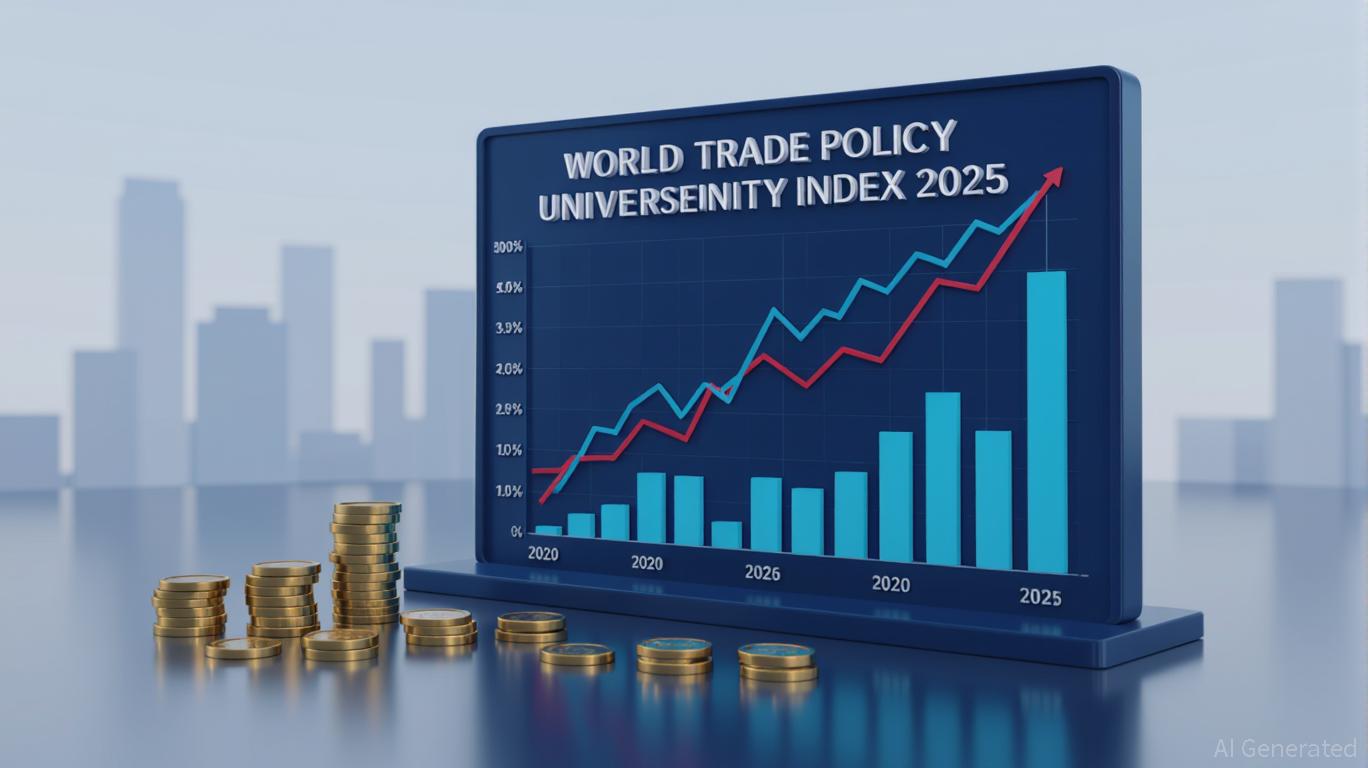
The U.S. trade policy landscape in Q3 2025 remains a volatile battleground, with uncertainty acting as a de facto tariff that reverberates across global markets. According to a report by UNCTAD, trade policy uncertainty has reached record levels, reshaping trade flows and stifling investment in commodity-dependent economies [1]. This systemic instability is not merely a political abstraction—it is a tangible force distorting supply chains, inflating costs, and eroding investor confidence.
Commodity Markets: A Tale of Two Sectors
The ripple effects of U.S. policy ambiguity are starkly visible in commodity markets. Energy and base metals, traditionally sensitive to macroeconomic cycles, are now doubly exposed to geopolitical and regulatory shocks. For instance, the OECD warns that uncertainty has weakened global growth projections, with industrial commodities like copper and aluminum facing subdued demand as firms delay capital expenditures [3]. Meanwhile, precious metals such as gold have surged to record highs, driven by a flight to safety amid inflationary pressures and fiscal uncertainty [1].
The U.S. dollar’s decline—trading at its weakest level since 2022—has further amplified these dynamics. As stated by S&P Global, dollar weakness has spurred gains in emerging market currencies like the Brazilian real, though domestic fiscal risks remain a drag [4]. This currency volatility creates a double-edged sword for commodity exporters: while weaker dollars boost export revenues, they also inflate import costs for critical inputs, squeezing margins in developing economies [2].
Industrial Sectors: Tariffs, Automation, and the Cost of Uncertainty
The U.S. industrial sector is grappling with a perfect storm of rising tariffs and supply chain disruptions. A 2025 analysis by Farmonaut highlights that new tariffs on Chinese imports have pushed manufacturing costs up by 15%, disproportionately affecting industries reliant on steel, aluminum, and auto parts [3]. To mitigate these shocks, firms are resorting to “front-loading” shipments, a practice that has spiked air freight demand and created artificial surges in import volumes [1].
Yet the most profound long-term shift may be the acceleration of automation. As noted by the Federal Reserve Bank of San Francisco, U.S. manufacturers are increasingly adopting industrial robots to reduce reliance on imported intermediate goods [2]. This trend, while costly upfront, could redefine global value chains by insulating firms from trade policy shocks. However, smaller enterprises—particularly in developing nations—lack the capital to pivot, leaving them vulnerable to prolonged downturns [1].
Financial Implications: Bonds, Stocks, and the Cost of Capital
Trade policy uncertainty has also triggered a reevaluation of risk across financial markets. S&P Global reports that bond market sell-offs and stock market corrections have become routine as investors price in regulatory headwinds [4]. The…
Read More: A Looming Shadow Over Industrial and Commodity Markets
