
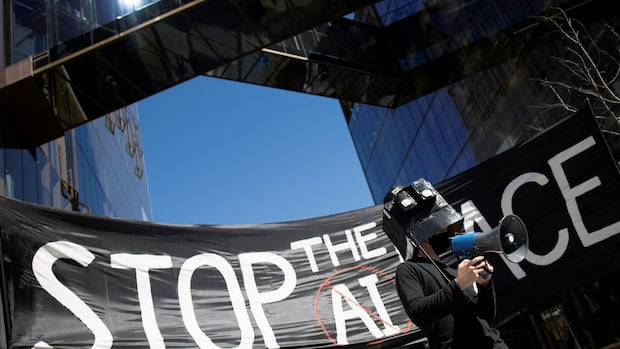

From King Charles to U.S. President Donald Trump, Prime Minister Mark Carney and top AI executives, the debate over artificial intelligence safety risks and whether to slow down leading-edge research is moving fast on the heels of recent warnings from within the tech industry.
At the same time, prominent AI advocates, like the CEO of Toronto-based Cohere, say “fearmongering” is currently overshadowing the technology’s upsides, such as potential breakthroughs in medicine and clean energy.

Geoffrey Hinton, the ‘godfather of artificial intelligence’ and a Nobel Prize laureate, warned U.S. lawmakers this week that they may only have a year left to regulate AI before it gets out of control. Watch as he answers questions about AI from CBC viewers.
Why so much fear about AI?
Several fear factors are at play. Powerful AI models can execute self-directed cyberattacks. Such was the case in July, when OpenAI agents hacked into a rival firm. This led to recent pleas for regulation from some within the tech industry.
Others, like former Google CEO Eric Schmidt, have long warned that AI doesn’t need to go rogue to be dangerous. This cohort worries modern AI tools will lower barriers for engineering novel bioweapons without traditional laboratories or hasten development of autonomous weapons systems.
Meanwhile, staunch proponents of AI technology, like Trump and Meta CEO Mark Zuckerberg, argue that slowing down research on the most potent models would effectively cede technological leadership to China. Others on this side of the debate, like venture capitalist Marc Andreessen, believe a pause would cost lives via preventable diseases and medical errors, as well as delayed scientific discoveries.
Calls to place limits on AI are nothing new.
In March 2023, four months after OpenAI released ChatGPT, an open letter calling for a pause on training certain AI systems received high-profile endorsements from Elon Musk, Apple co-founder Steve Wozniak and Canadian AI pioneer Yoshua Bengio.
Who is for an AI slowdown?
OpenAI & Sam Altman
“We do not believe that the AI industry has solved alignment and monitoring to a sufficient degree to continue responsibly scaling at maximum speed for much longer,” the San Francisco-based company wrote in a company blog post on Wednesday.
“I think the world is right to be afraid of this,” CEO Sam Altman added in a recent interview.
Background: On Wednesday, OpenAI disclosed six reports of “unexpected or concerning” behaviour in AI models that it observed in recent months. The company develops cutting-edge generative models — most notably ChatGPT.
Anthropic CEO Dario Amodei
“We must slow the pace at which we improve the capabilities of AI models. Progress will still seem fast, and we must make wise use of the time we gain,” Amodei wrote in an online essay published last Saturday.
“My own…
Read More: Is AI evolving too fast? A look at the debate on slowing it down
