

As President Donald Trump’s tariff threats continue to hang over Canada, B.C. Premier David Eby wants the federal government to impose a tax on U.S. thermal coal shipped out of the province as a way to pressure the White House.
But after the president lashed out at Canada for Ontario’s levies, there are also fears that any more retaliation from provinces could backfire.
B.C. ports are a “lifeline” for Montana and Wyoming, which rely on their northern neighbour to get their coal to Asian markets, according to Tony Knutson, global head of Wood Mackenzie’s thermal coal markets.
“There’s no other choices on the West Coast right now,” Knutson said in an interview with CBC News.
In 2024, the Port of Vancouver handled nearly 17.4 million metric tonnes of thermal coal, according to the Vancouver Fraser Port Authority. Almost three-quarters came from the U.S. and were shipped to overseas markets, including South Korea and Japan.
On Monday, Eby said he presented a proposal directly to outgoing Prime Minister Justin Trudeau to put levies on U.S. coal exports or even restrict them entirely. In 2021, the federal government promised to ban thermal coal exports by 2030.
“So it’s something in line with the values of the outgoing prime minister and what his priorities were,” Eby said.
The idea has also been floated by B.C. Opposition Leader John Rustad. Energy experts say such a tax would hurt U.S. coal exporters and could get Trump’s attention. Environmentalists also support the levy, viewing it as a victory in the fight against climate change.
U.S. reliance
Thermal coal — which is nearly universally maligned for its high emissions — is used to make steam that produces electricity.
The exporting of U.S. coal is a billion-dollar industry that boomed in the last two decades after the States stopped relying on coal for most of its electricity usage due to a surge in natural gas production, said University of British Columbia professor Kathryn Harrison, who studies energy policy.

The U.S. needs to export coal through Canada because it doesn’t have any ports of its own that are large enough or close enough to Asian markets, she said.
Washington state and Oregon have blocked the development of coal exporting facilities due to environmental concerns.
“The U.S. is exporting its thermal coal through Canada because we’ve been willing to export it,” Harrison said.
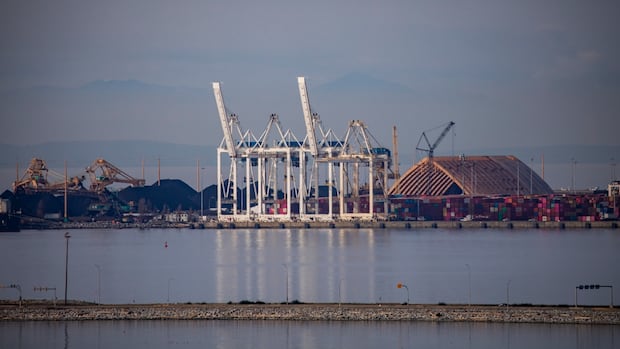
Coal from the Powder River Basin in southeast Montana and northeast Wyoming is transported by rail from the U.S. and is then shipped out of B.C., mostly to the Westshore Terminals in Delta, B.C.
Imposing a levy to regulate trade is the federal government’s responsibility. In a statement, Global Affairs Canada said, “All options remain on the table as the government considers additional measures, including non-tariff options, should the U.S. continue to…
Read More: B.C. premier calls for levies on U.S. thermal coal exports in response to
