
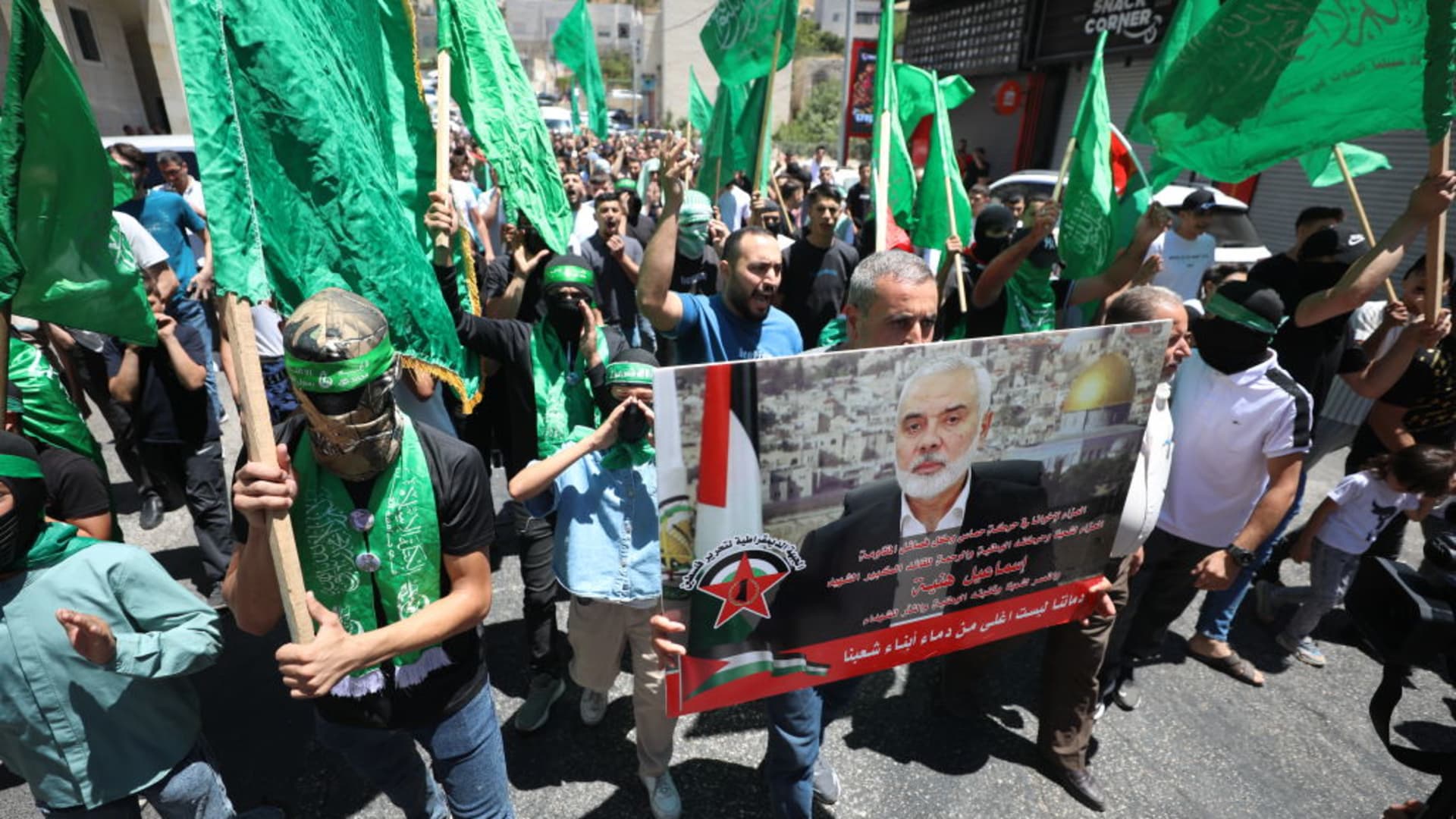


U.S. crude oil futures jumped more than 3% on Wednesday after Hamas political leader Ismail Haniyeh was assassinated in Tehran, Iran, renewing fears that the Middle East is teetering on the brink of a regional war.
Here are Wednesday’s energy prices:
- West Texas Intermediate September contract: $77.28 per barrel, up $2.55, or 3.51%. Year to date, U.S. oil has gained 7.9%.
- Brent September contract: $80.73 per barrel, up $2.10, or 2.67%. Year to date, the global benchmark is ahead 4.8%.
- RBOB Gasoline August contract: $2.44 per gallon, up 5 cents, or 2.41%. Year to date, gasoline is up 16.2%.
- Natural Gas September contract: $2.08 per thousand cubic feet, up 4 cents, or 2.07%. Year to date, gas is down 17%
Iran’s paramilitary Revolutionary Guard accused Israel of assassinating Haniyeh at his residence in Tehran. Iran’s supreme leader, Ayatollah Ali Khamenei, said it is Iran’s duty to punish Israel for this action, according to a Google-translated report from the state-run Islamic Republic News Agency.
Haniyeh’s assassination casts even more uncertainty over a potential Gaza cease-fire deal between Israel and Hamas. Haniyeh was a senior negotiator in the talks.
CNBC has reached out for comment to the Israeli Ministry of Foreign Affairs and Prime Minister’s Office.
Israel has been fighting Hamas for nine months since the Iran-backed militant group launched a brutal terrorist attack in October that killed hundreds of Israelis.
Israel’s retaliatory campaign has devastated the Gaza Strip, threatening to broaden the conflict as the country has traded fire with other Iran-supported factions, such as Lebanon’s Hezbollah and Yemen’s Houthi.
Oil markets have so far absorbed the shocks of inching escalations in the Middle East, which were intermittently exacerbated by trade disruptions caused by Yemeni maritime attacks and by episodes of direct hostilities between Israel and Iran or Hezbollah.
Clay Seigle, director of the global oil service at Rapidan Energy Group, told CNBC’s Emily Tan that oil traders have been “mispricing” the geopolitical risks in the Middle East, with the market left “a bit sanguine” by an expected disruption of barrels in the wake of Russia’s war in Ukraine that “never materialized,” along with a 10-month simmering conflict in the Gaza enclave.

“But now we’re moving into a phase of deterioration into the Middle East that we believe is going to capture oil traders’ attention and get them to return some material risk premium into the price of Brent. At least $5 [per barrel] to start, even before we see a potential physical supply disruption,” he said.
“The events that we’ve seen over the past 1-3 days have marked a fairly sharp deterioration that has the potential to break us out of this phase of contained escalation between the sides that we’ve seen really since Oct. 7 and take us into new territory for oil and gas markets,” he added.
Other analysts questioned the potential of the latest escalation to shore up oil prices in the long term.
“I…
Read More: U.S. crude oil jumps more than 3% after Hamas political leader assassinated
