


Listen to this article
Estimated 5 minutes
The audio version of this article is generated by AI-based technology. Mispronunciations can occur. We are working with our partners to continually review and improve the results.
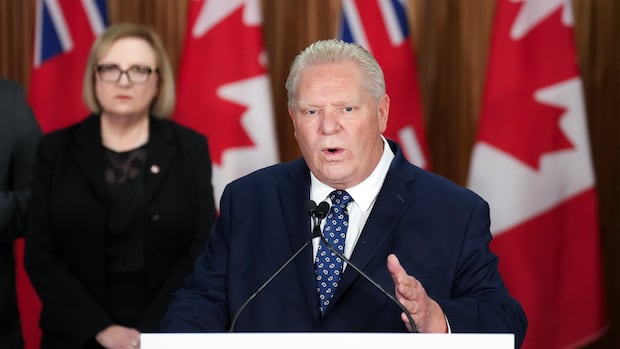
Ontario Premier Doug Ford and Unifor president Lana Payne are calling on Ottawa to exempt automakers from penalties for failing to comply with the government’s tailpipe emission standards.
In a joint statement released Thursday, the two leaders say the penalties will force manufacturers to buy credits from other automakers that do not build in Canada.
“These additional costs are an ‘own goal’ that are helping President Trump achieve his objective of putting every single Canadian autoworker out of a job,” the statement reads.
“Exempting Canadian automakers from non-compliance penalties must come with a firm commitment that automotive production will be preserved in Canada, including a full reversal of the sale of the Stellantis Brampton Assembly Plant.”
The federal government has proposed introducing more stringent tailpipe emission standards to replace its electric vehicle mandate, which it scrapped last year. Last month, Prime Minister Mark Carney said those new standards would be delayed, maintaining the current 2026 standards until at least 2029.
Carney said at the time the move would give Canada’s automakers some breathing room in the face of U.S. tariffs, while helping Canada reach its emission reductions “in the long term.”
Canada has had emissions credit system since 2010
The tailpipe emission standards currently in place applies to a manufacturer’s entire fleet. To be compliant, carmakers can either improve fuel efficiency on individual vehicles, or sell more fuel-efficient models to offset the sales of less efficient ones.
“But in the event that you’ve reached the limit of those technological efficiencies, or your fleet does not allow you to achieve the efficiency that is set or the targets that are set by government, there are credits available to allow you to comply,” said Brian Kingston, the head of the Canadian Vehicle Manufacturers’ Association which represents the Canadian divisions of Ford, General Motors, and Stellantis.
“So you purchase credits from another manufacturer that has a surplus.”
Canada has had a fleet emissions credit system since 2010, and began enforcing it since the 2011 model year. Automakers can generate credits when their fleet’s total emissions perform better than what the regulations call for.
While credits earned between 2010 and 2016 could be applied up until model year 2021, credits since then only have a five-year shelf life.

A new report from the Canadian Climate Institute says the country’s greenhouse gas emissions increased in 2025 — further distancing Canada from meeting its 2030 climate goals. Asked by Power & Politics if her government will shift those…
Read More: Ford, Unifor call on Ottawa to exempt Canadian automakers from exhaust
