
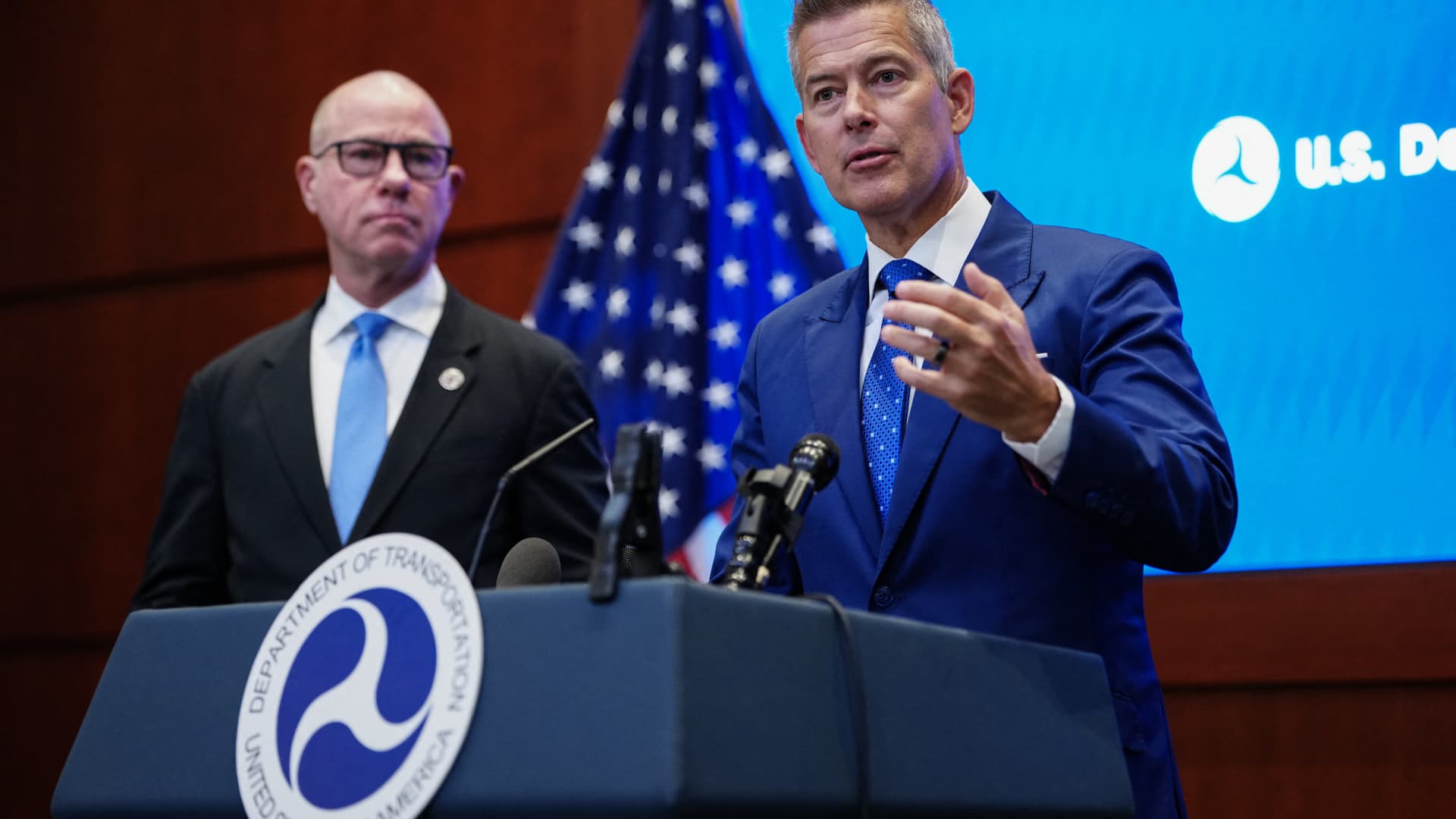

US Transportation Secretary Sean Duffy (R) speaks alongside FAA Administrator Bryan Bedford (L) during a press briefing at the Department of Transportation headquarters building in Washington, DC, on November 14, 2026.
Aaron Schwartz | Afp | Getty Images
The longest halt in flight departures to U.S. airports since 9/11 came after updates to a telecommunications system managed by contractor L3Harris Technologies, Transportation Secretary Sean Duffy said Saturday, as hundreds of thousands of travelers were stranded by lingering disruptions.
There was “zero evidence” that the problem was caused by something “nefarious” or anything related to artificial intelligence, Bryan Bedford, the head of the Federal Aviation Administration, said at a press conference with Duffy.
The upgrades at “at least” one remote location were part of ongoing work of switching from a copper wire system to fiber, Duffy said.
A router had “flooded” other routers in the air traffic control system with over 1,000 connection attempts roughly every five seconds, the secretary said, creating problems with airplane communications and radar feeds.
The outage again thrust aging infrastructure that underpins U.S. air traffic control into the spotlight, along with the country’s struggles to replace sections of it while operating the world’s busiest airspace.
“What we’re working to determine was whether we had incompetence, meaning was it user error, installator error from L3 Harris, or did they install a faulty router,” he said.
L3Harris said it is “supporting the FAA in its investigation to understand the conditions that led to the Nov. 13 ground stop of our nation’s air travel.”
L3Harris said it has completed more than 70% of the switch from copper wiring to fiber-optic system.
Duffy took the groundstop to seek billions more from lawmakers to modernize the system.
Bedford said no FAA facilities went dark but that officials decided to ground flights because of “instability” in information feeds to air traffic control centers that handle en route aircraft at high altitudes and eventually to others closer to airports.
“We were unwilling to take any risk that this propagation could actually result in a center losing connectivity with aircraft,” said Bedford. He said officials weren’t sure for about 45 minutes what was causing the instability.
Flight disruptions mount
Flight disruptions continued on Saturday. Nearly 6,500 U.S. flights were canceled Saturday and more than 8,000 were delayed as of 9 p.m. ET, according to flight-tracking site FlightAware. That’s on top of more than 9,000 U.S. flight cancellations, about a third of the day’s schedule, and more than 7,000 delays on Friday, though some disruptions were due to bad weather.
Friday had the second-highest U.S. flight cancellations since a severe blizzard and below-freezing temperatures in January, according to aviation-data firm Cirium.
People check in for their flights after the US Federal Aviation Administration (FAA) lifted a nationwide…
Read More: Ground stop followed contractor upgrade to L3Harris telecom system: Duffy
