
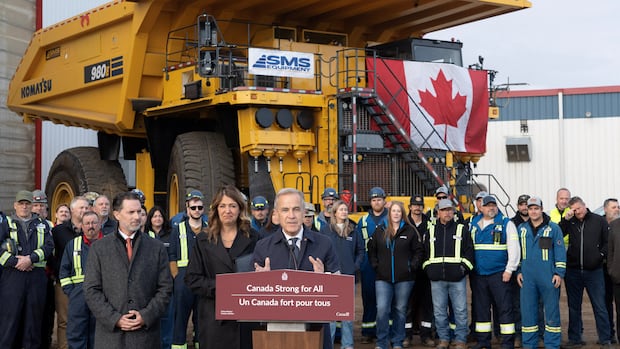

A proposed pipeline carrying one million barrels of oil a day from Alberta to the B.C. coast has become the first project designated in the national interest, the federal and Alberta governments have announced.
Listing the West Coast Pacific Link oil pipeline on Schedule 1 of the Building Canada Act means the federal government has moved from considering whether it should be built to how it will be built by fast-tracking and consolidating the approval process, including environmental assessments.
“Before the Building Canada Act, proponents would have to spend years and potentially billions of dollars doing this work before even knowing where the federal government stood on the project,” Carney said in Fort McMurray, Alta., on Thursday.
“For many builders, the risk was not worth it. So, Canada stopped building. Now, the federal government is making its position clear at the beginning of the process, rather than at the end.”

Prime Minister Mark Carney says the Major Projects Office will work to ‘finalise conditions’ by Sept. 1, 2027 to ‘get shovels in the ground’ on an oil pipeline to B.C.’s southern coast.
A senior government official told reporters in advance of the announcement that the pipeline is expected to boost Canada’s GDP by up to $30 billion annually — $20 billion of that coming from the pipeline itself.
By diversifying Canada’s exports away from the U.S., officials said Canada will be able to charge a higher price for the oil it currently ships south of the border, providing what could be an additional $10 billion a year in revenues.
The federal government also said that once approved, the project will create up to 140,000 jobs.
Dominic LeBlanc, the minister of one Canadian economy, has been tasked with completing the conditions document setting out the requirements for the project by Sept. 1, 2027, allowing construction to begin, with a view to having the pipeline up and running by 2032-33.
Carney said the work of crafting those conditions will be supported by the Major Projects Office and the Canada Energy Regulator who will hold consultations with stakeholders to determine environmental protections, oversight, Indigenous ownership and local hiring.
The estimated cost of the project is between $35.2 billion and $43.7 billion, which includes a contingency.
The Alberta government and the federally owned Trans Mountain Corporation would each own 45 per cent of the pipeline, with the Calgary-based Pembina Pipeline Corporation owning a 10 per cent stake through the construction phase.
Once the pipeline is up and running, the Pembina Pipeline Corporation will have the opportunity to purchase an additional 10 per cent stake.
Carney said that Indigenous communities will be offered a minimum 10 per cent ownership stake in the project.
Increasing private sector ownership
While the pipeline is…
Read More: West Coast oil pipeline becomes 1st project designated in national interest
