

Dubai: The UAE Islamic Finance and Halal Industry Strategy targets Dhs2.56 trillion in local Islamic finance assets by 2031. Islamic banking assets in the country reached Dhs1.4 trillion in June 2026, with 43 licensed Islamic financial institutions operating in the country, while the UAE ranked third globally in the 2025 Islamic Finance Development Indicator.
Al Masraf, in collaboration with the UAE Banks Federation, concluded its inaugural conference on “The Role of Financial Institutions in Implementing the UAE Islamic Finance and Halal Industry Strategy 2025 – 2031,” held at Grand Hyatt Dubai under the theme “From Legislation to Growth and Innovation.”
The conference aimed to strengthen the UAE’s position as a leading global hub for Islamic finance, highlight the UAE Strategy for Islamic Finance and the Halal Industry and clarify the role of financial institutions in supporting and implementing it locally and internationally.
The conference focused on translating legislative and strategic frameworks into practical tools and initiatives across financing, investment, sukuk, technology, governance and cash waqf, to support implementation of the Strategy and strengthen integration between Islamic finance and the halal industry.
The conference was opened by Dr Omar Alderei, Chairman of the General Authority of Islamic Affairs, Endowments and Zakat, in the presence of Abdulla Ahmed Al Saleh, Undersecretary at the Ministry of Economy and Tourism and Mohamed Omran Al Shamsi, Deputy Chairman of the UAE Banks Federation.
It brought together leading Shari’ah scholars; representatives of the Central Bank and regulatory authorities; senior executives from Islamic financial institutions; and specialists in awqaf, zakat, philanthropy, takaful, higher education and the media.
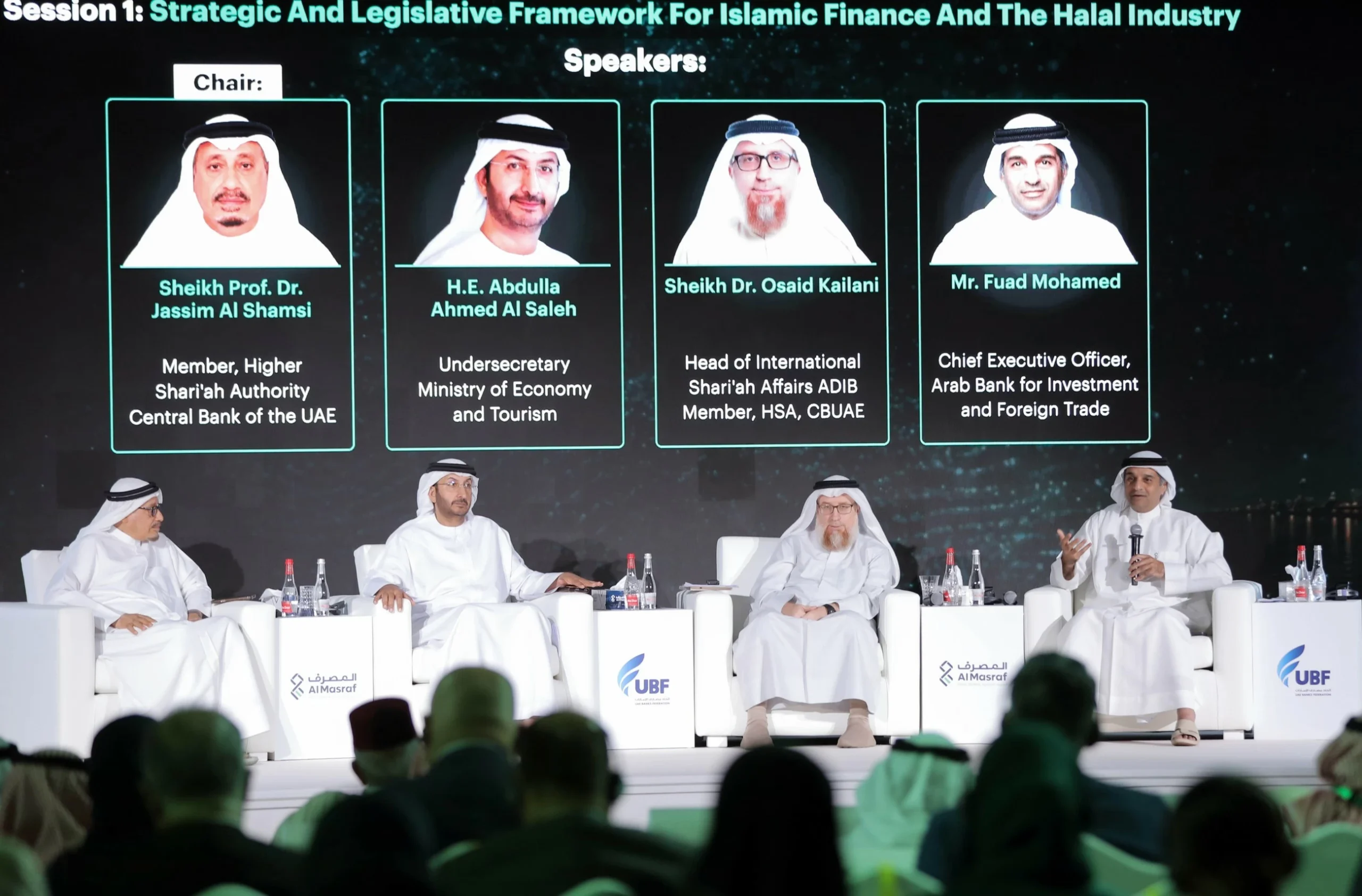
Strategic and Legislative Framework: The first session was attended by Abdulla Ahmed Al Saleh, Undersecretary at the Ministry of Economy and Tourism, and was chaired by Sheikh Prof. Dr Jassim Al Shamsi, Member of the Higher Shari’ah Authority at the Central Bank of the UAE, along with Sheikh Dr Osaid Kailani, Head of International Shari’ah Affairs at Abu Dhabi Islamic Bank and Member of the Higher Shari’ah Authority at the Central Bank of the UAE; and Fuad Mohamed, Chief Executive Officer of Arab Bank for Investment and Foreign Trade.
The discussion focused on the UAE’s vision and strategic objectives for Islamic finance and the halal industry, together with the legislative, regulatory and Shari’ah frameworks supporting implementation, growth and innovation. It also addressed the importance of closer integration among regulators, financial institutions, the halal industry and philanthropy.
Participants highlighted the progress made in developing the UAE’s legislative environment for Islamic finance, alongside the importance of strengthening legal and Shari’ah certainty and further harmonising relevant standards and…
Read More: Conference identifies practical priorities of the UAE Isl…
