
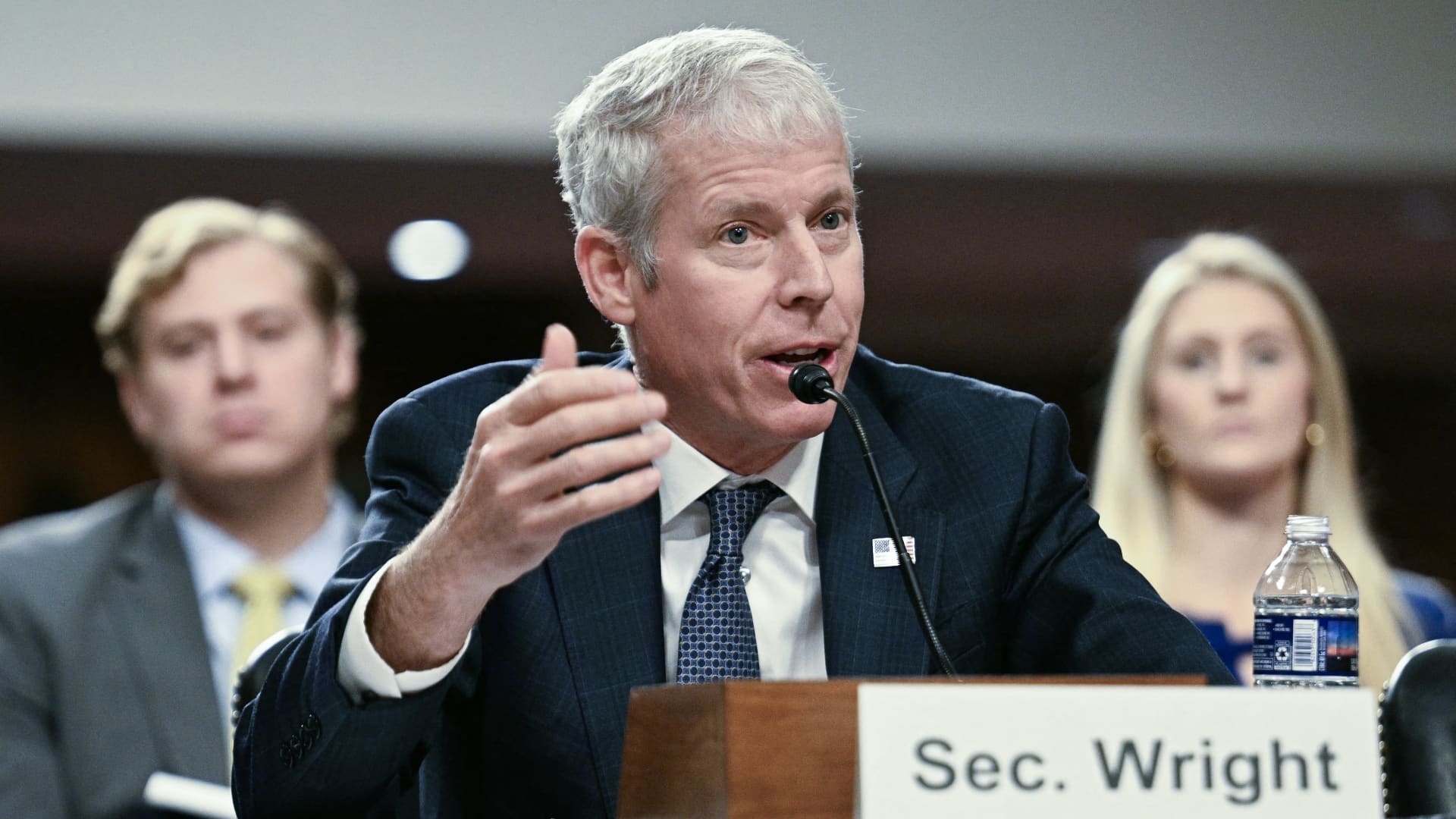

US Energy Secretary Chris Wright testifies before a Senate Committee on Armed Services Committee hearing to examine the 2027 budget for the Department of Energy and National Nuclear Security Administration on Capitol Hill in Washington, DC, on May 13, 2026.
Jim Watson | Afp | Getty Images
U.S. Energy Secretary Chris Wright on Sunday said the U.S. may not reach an elusive deal to constrain Iran from obtaining a nuclear weapon, as the U.S.-Iran conflict enters its seventh month.
“There may not be a nuclear agreement. It may be simply destroying their capabilities to do it,” Wright said on ABC News’ “This Week.” “An agreement may await the next administration in Iran. We simply don’t know that.”
Trump has repeatedly said preventing Iran from obtaining a nuclear weapon is a central objective of the U.S. campaign. He has also sought a negotiated deal with Iran throughout the war, which has sent energy prices soaring worldwide.
Wright’s comments suggest the administration may pursue its goal of preventing an Iranian nuclear weapon without reaching a negotiated nuclear agreement.
Pressed on whether Wright’s comments mean the U.S. will continue striking Iran when it attempts to rebuild its nuclear infrastructure, the energy secretary said, “You have to destroy their capabilities to do it.”
“We are degrading their capacity to develop nuclear weapons and ultimately to deliver them if they develop them,” he said. “It is a 47-year-long effort. This is not trivial, but the United States will get the job done and we will work in cooperation with our allies in the region.”
Asked about his comments again later during an appearance on CBS’ “Face the Nation,” Wright said President Donald Trump’s preference “is always to have a negotiated settlement and not use a military solution unless absolutely necessary.”
“The biggest role of our military in the region right now is to stop the export of any Iranian crude or crude-related products, natural gas, whatever,” he said. “We are strangling their economy to try to bring either a change in policy from the existing regime or a new regime.”
Iran threatens the U.S.
Iran’s “proportionate responses” to U.S. attacks are over, the country’s parliament speaker and top negotiator Mohammad Bagher Ghalibaf said Sunday, while acknowledging the economic impact of the war.
“If they haven’t understood by now, they should understand before it’s too late that the rules of the game have changed and that from now on, any violation of Iran’s interests and security will receive a ‘faster, heavier, and more painful’ response,” Ghalibaf said in a post on Telegram.
But Ghalibaf added that alongside the military conflict, Iran faces severe economic pressures.
“Severe fluctuations in the exchange rate, inflation, unemployment, and market management are fundamental challenges that have put serious pressure on people’s livelihoods,” Ghalibaf said.
He also stressed the need to rely more on domestic production and use technology to “devise short-term and…
Read More: U.S. may not reach nuclear deal with Iran
