
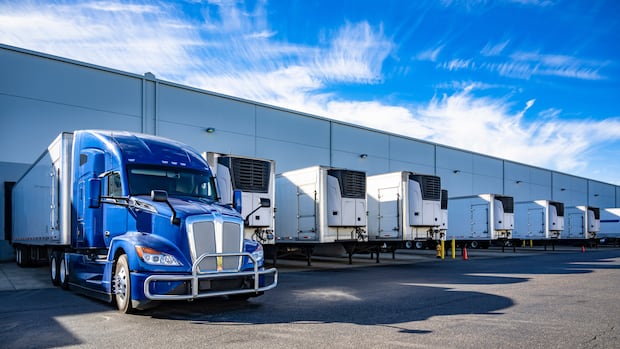

Canadians bracing for billions of dollars in counter-tariffs won’t just see prices rise on American aluminum, toilet paper, furniture and more — but on the very semi-trailers hauling those goods into and around the country.
Ocean Trailer, the largest retailer of semi-trailers in Western Canada, is waiting on a $45-million order of 600 trailers from U.S. manufacturers.
The company is rushing to get as many over the border before a 25 per cent Canadian counter-tariff on trailers, and scores of other items, takes effect on Tuesday.
“The extra cost, the 25 per cent, is well above our profit margin on a trailer, so we would have no choice but to pass that along to the customer,” said Mack Keay, Ocean Trailer’s chief operating officer, told CBC News from Vancouver.
The federal government announced dollar-for-dollar countermeasures will take effect at 12:01 a.m. on Tuesday on $27.6 billion worth of U.S. goods , in response to the latest round of tariffs imposed by President Donald Trump’s administration.
Keay said it’s possible Ocean Trailer may be able to cancel some of its order, which was expected to flow in trailer by trailer until the end of the year, but it’s on the hook for the trailers that are already in the process of being fabricated in the U.S.
The ones the company can’t get into Canada by Sept. 8 will have to be parked somewhere in the U.S. or sold to American-based retailers, and Keay said he wouldn’t get back what he paid for them.
Industry ‘very much concerned’
Ocean Trailer isn’t alone.
The head of the Manitoba Trucking Association said the vast majority of semi-trailers in Canada come from the U.S.
“I know a number of members that currently have trailers on order and are very much concerned about the cost of those trailers, because they ordered them before the counter-tariffs,” said executive director Aaron Dolyniuk.
“I don’t know that they’ll be able to afford to pay 25 per cent more for them when they get here.”
Dolyniuk said many businesses that rely on those trucking companies to ship product are also “rushing to get things north of the border before the [counter-]tariffs come on.”
“I was talking to one member late last week … [who] said normally, they hauled two loads for this one customer northbound, and they wanted 15 this week,” he said.
A variety of types of semi-trailers are towed along Canadian roadways, but the two most common are called dry vans and refrigerated vans.
The latter, also known as “reefer” vans, haul groceries, pharmaceuticals and other items that need temperature-controlled conditions during transport to avoid spoilage.
Dry van trailers are used to haul everything from kitchen appliances to car and machine parts, paper products, furniture, televisions, canned goods and other non-perishable items.
‘This is not going to be OK’
There are just two semi-trailer manufacturers in Canada — one based in Ontario that doesn’t manufacture reefer van trailers and another in Quebec which does, along with making dry vans, flat…
Read More: Counter-tariffs won’t just affect the cost of goods for Canadians. They’ll
