

When Canada announced earlier this year that it would allow a token number of Chinese-made electric vehicles into the country, the gesture didn’t seem so much about climate action as a sop to ease Chinese tariffs on Canadian canola.
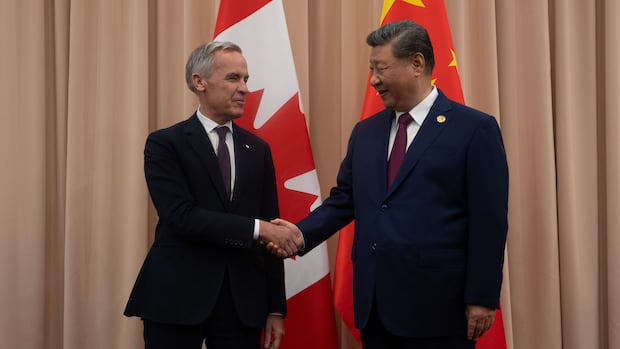
Now, it very much appears like the opening gambit in a deeper engagement with China on clean energy. Following up on Prime Minister Mark Carney’s momentous meeting with Chinese Premier Xi Jinping in January, Industry Minister Melanie Joly was in Beijing last month to discuss the feasibility of Canadian-Chinese EV ventures.
Meanwhile, the Canada China Business Council is organizing a cleantech mission to China in Beijing in November.
While Carney has gone to great lengths recently to placate Canada’s fossil fuel industry — most notably by promising a new pipeline to the B.C. coast — some experts suggest a new relationship with China could provide an efficient way to get back on track with the clean energy transition that much of the rest of the world is already undertaking.

“China is a global clean energy superpower,” said Rachel Doran, executive director of Clean Energy Canada, and given the size and sophistication of China’s sector, Canada “can’t have a strategy around the transition that the world is experiencing without having a strategy around China.”
“I think that has motivated some of what the [Canadian] government has tried to do.”
China as clean-energy partner
China’s dominance in clean-energy manufacturing is staggering. It’s responsible for around 80 per cent of the world’s solar panels, 60 per cent of wind turbines and 75 per cent of electric vehicles and their batteries, according to the Climate Action Tracker.
Earlier this year, Chinese manufacturer BYD surpassed Tesla in global EV sales for the first time. To illustrate its rapid rise, China went from exporting 28,000 EVs in June 2019 to exporting 316,000 in June 2026.

China is already partnering with other countries on clean energy — such as a venture with the United Arab Emirates to build out wind and solar projects in the Global South.
According to Bijan Ahmadi, executive director and COO of the Canada China Business Council, there are opportunities for Canada to align “with China’s manufacturing scale, capital and ability to deploy technology rapidly.”
“The new Canada-China strategic partnership provides a foundation for this work, specifically identifying clean technology, batteries, solar, wind and energy storage as areas for potential cooperation,” he said.
Back in 2024, Canada imposed 100 per cent tariffs on Chinese EVs, largely at the behest of our southern…
Read More: Are there climate benefits to Canada’s new relationship with China?
