
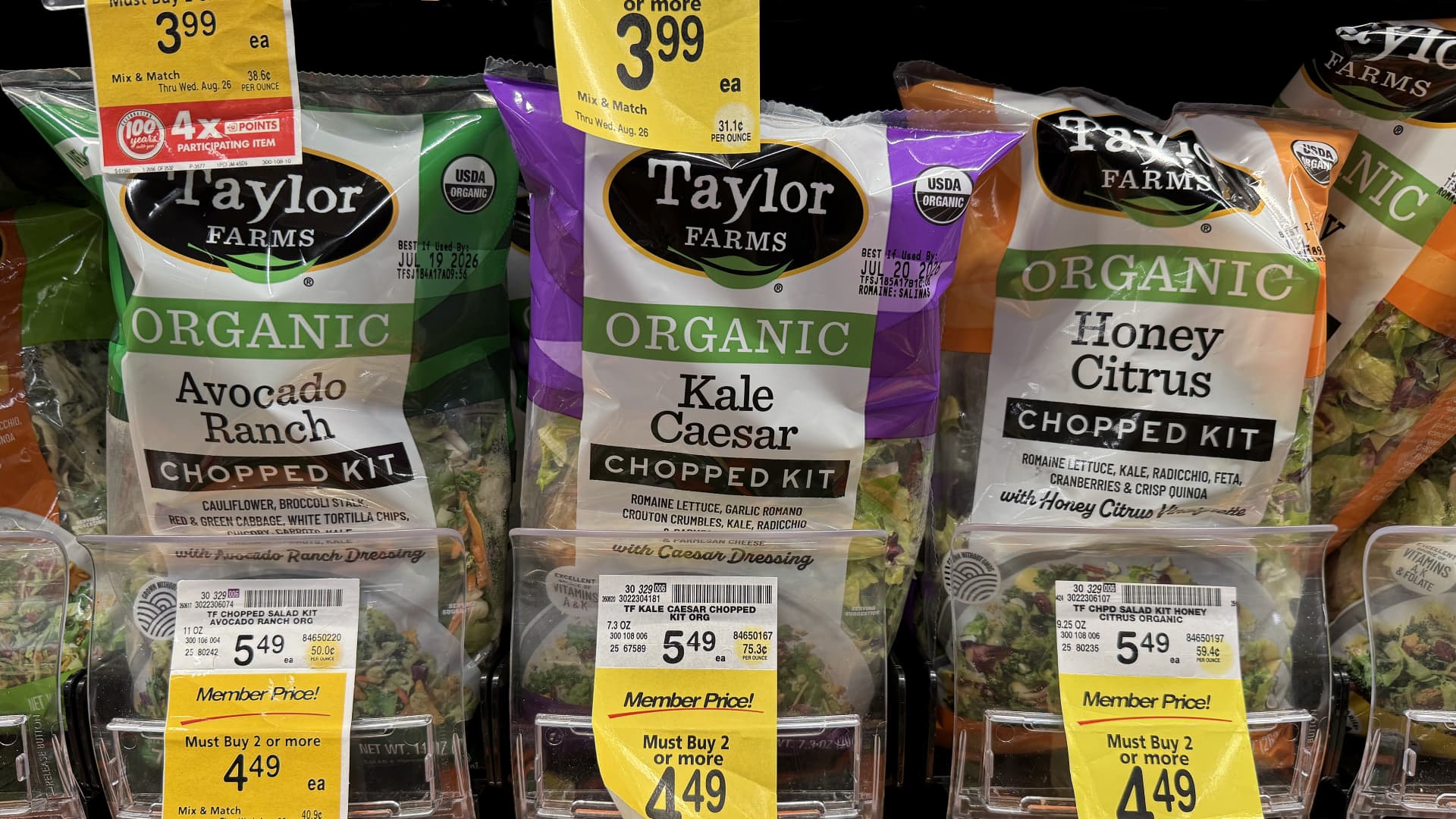

Packages of Taylor Farms salad greens are displayed at a Safeway store on July 16, 2026 in Kings Beach, California.
Justin Sullivan | Getty Images
The Food and Drug Administration’s reversal on a key piece of its cyclosporiasis investigation has sparked confusion in the U.S., but the agency said Monday that it has not changed its main conclusions about the outbreak.
The agency said Sunday a test that indicated a sample of iceberg lettuce supplied by Taylor Farms de Mexico carried the cyclospora parasite was a false positive. However, that only applies to one specific shipment of lettuce supplied by the company, which the agency does not believe was the vehicle that sickened more than 1,600 people and potentially thousands of others.
In a Monday clarification, the agency said its false positive does not change its prior conclusion that the outbreak is linked to shredded iceberg lettuce from central Mexico supplied by Taylor Farms, which was also served at some Taco Bell locations. The agency is still advising Americans not to eat recalled iceberg lettuce.
“FDA’s traceback investigation and outbreak data continue to converge on shredded iceberg lettuce from Taylor Farms locations in central Mexico,” it said in a statement. “FDA will continue to work with federal and state partners to investigate this multistate outbreak and ensure products implicated in this outbreak have been removed from the market.”
Investigators are continuing to examine what exactly caused the outbreak, which can lead to symptoms similar to a bad stomach bug for days or even weeks. CNBC has reached out to the FDA for details on the next phase of the investigation, including whether additional ingredients or suppliers are under scrutiny and whether the agency expects to issue further guidance. The agency has not yet responded.
The false positive test comes as the developing investigation creates uncertainty for both consumers and the food industry. While the FDA has said not to eat iceberg lettuce from Taylor Farms, some diners have stayed away from salads altogether as the number of cases rises.
“Unfortunately, this latest development may add further confusion to what has already been a complex situation for consumers,” said Frank Yiannas, former deputy commissioner of food policy and response at the FDA.
Though industry analysts do not expect the outbreak to have a long-term impact on Taco Bell or other restaurant chains, it could at least temporarily hit sales, based on foot traffic data, and cause a one-to-two quarter hit for companies linked to it. Foot traffic at Taco Bell sank roughly 19% on Friday compared to the day-of-the-week average so far this year, according to data from research firm Placer.ai.
What the FDA’s false positive means
In foodborne outbreak investigations, a false positive can happen when an initial screening signal isn’t reproduced during confirmation testing. Some doctors have pointed out that cyclospora is particularly challenging to recreate in the…
Read More: What FDA Taylor Farms lettuce false positive means
