

China’s Belt and Road Initiative, the world’s largest ongoing infrastructure program, has a substantial climate impact. More than half its emissions stem from steel, the majority of which was produced in China.
Cutting the emissions will require stronger environmental policies and major investment in cleaner manufacturing technologies, two new studies concluded.
More than 130 million tons of carbon dioxide equivalent emissions are tied to the construction of transportation, energy, building and water projects that were part of China’s Belt and Road international development initiative from 2008 to 2024, according to a study published Monday in the journal Environmental Science & Technology. The study, a global, project-level assessment of greenhouse gas emissions, tallied climate pollution linked to more than 700 Belt and Road construction projects across 105 countries.
The Belt and Road Initiative is China’s trillion-dollar development effort designed to help expand Beijing’s global influence. The emissions it produced from the 700 construction projects analyzed in the study were equivalent to the annual climate pollution from 35 coal-fired power plants, according to the U.S. Environmental Protection Agency’s greenhouse gas equivalency calculator.
Roughly half of all greenhouse gas emissions associated with these projects were generated outside the countries in which the projects were completed.
“It’s not only about the host country, but also all the actors through the supply chain [that] will be affecting those embodied emissions,” said Lingli Hou, a researcher at Leiden University in the Netherlands, and the study’s lead author.
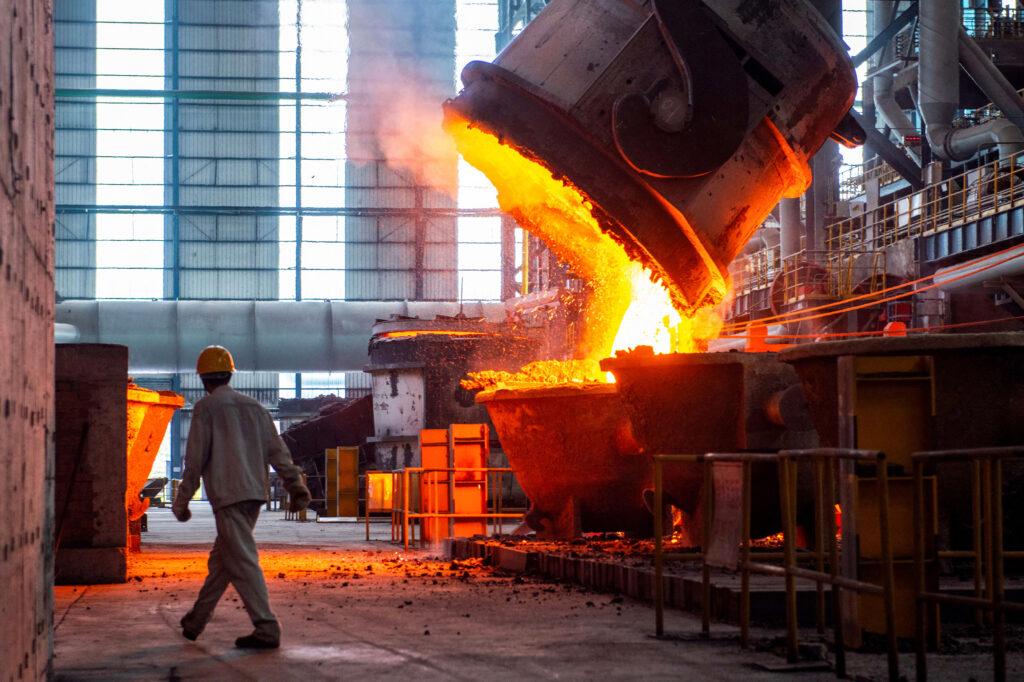
Carbon-intensive steel accounted for 53 percent of the projects’ total emissions, according to the study. China was the dominant source of emissions from steel manufacturing, making the country a major source of supply-chain emissions across the Belt and Road projects.
China produces more than half of all steel worldwide, and its manufacturing accounts for approximately 15 percent of the country’s total carbon dioxide emissions. The country’s ability to reduce emissions from steel production will play a key role in determining whether it can meet its climate goals of peaking greenhouse gas emissions by 2030 and achieving carbon neutrality by 2060.
“Around 90 percent of China’s steel is still produced using the dirtiest route by firing coal in blast furnaces,” Kate Logan, director of the China Climate Hub & Climate Diplomacy for the Asia Society Policy Institute, said in a written statement. “This makes China’s steel sector a hotspot for global emissions—but also a huge opportunity if it can be cleaned up.”
A combination of carrot-and-stick policies that incentivize cleaner technologies while placing a price on carbon is needed to hasten this transition, a study published Monday in the Proceedings of the National Academy of Sciences…
Read More: Driven by Steel Production, China’s Belt and Road Construction Carries a
