


NASA is introducing the four astronauts of the next Artemis moon program mission on Tuesday. The announcement at the Johnson Space Center in Houston kicks off a year or more of mission-specific training for the Artemis III crew.
They are expected to launch into Earth orbit next year to test rendezvous and docking procedures with moon landers being built by SpaceX and Blue Origin — a critical milestone before the U.S. can send astronauts back to the moon for landing in 2028.
What the Artemis III mission will do
The Artemis III crew will need to master the same operations that will be carried out in lunar orbit on a subsequent flight before America’s first moon landing in nearly 55 years.
Launching in an Orion capsule atop NASA’s Space Launch System rocket, the Artemis III crew will carry out a mission similar to NASA’s Apollo 9 flight in March 1969 when three astronauts tested the spindly lunar excursion module in Earth orbit. That flight came after a successful lunar orbit mission, Apollo 8, at the end of 1968.
Then the Apollo 10 flight tested the lunar module in orbit around the moon before Apollo 11 finally made the first moon landing in the Sea of Tranquility in July 1969.
The Artemis program’s version of Apollo 8, sending Artemis II commander Reid Wiseman, Victor Glover, Christina Koch and Canadian astronaut Jeremy Hansen on a flight around the moon, was successfully completed in April.
NASA’s plans for a moon landing
As of now, Artemis III is the only test flight NASA is planning before making a landing attempt in 2028 with whichever lunar lander is available. By that point, one or both companies will have had to complete a successful unpiloted moon landing.
NASA 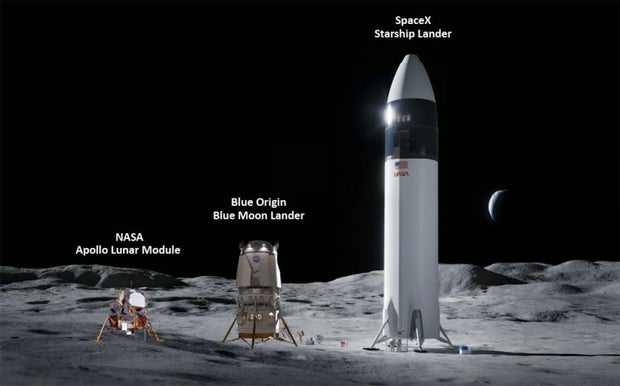
The Artemis III crew announcement comes as Blue Origin continues to recover from a catastrophic launch pad explosion May 28 that destroyed a New Glenn rocket like the one that will be needed to carry the company’s Blue Moon Mark II lander into Earth orbit next year. The company’s only launch pad, located at the Cape Canaveral Space Force Station in Florida, suffered major damage.
The Jeff Bezos-owned company says it expects to return to flight before the end of the year, but the mishap threw a wrench into the New Glenn launch schedule, delaying flights of the Blue Moon Mark I, an uncrewed lunar cargo ship, that was expected to have helped pave the way for the larger, more capable piloted version.
Whether the New Glenn rocket and pad 36 at the Cape Canaveral Space Force Station will be back in operation in time to launch a flight-ready Mark II lander in time for Artemis III remains…
Read More: Watch Live: NASA names 4 astronauts to crew of next Artemis mission
