
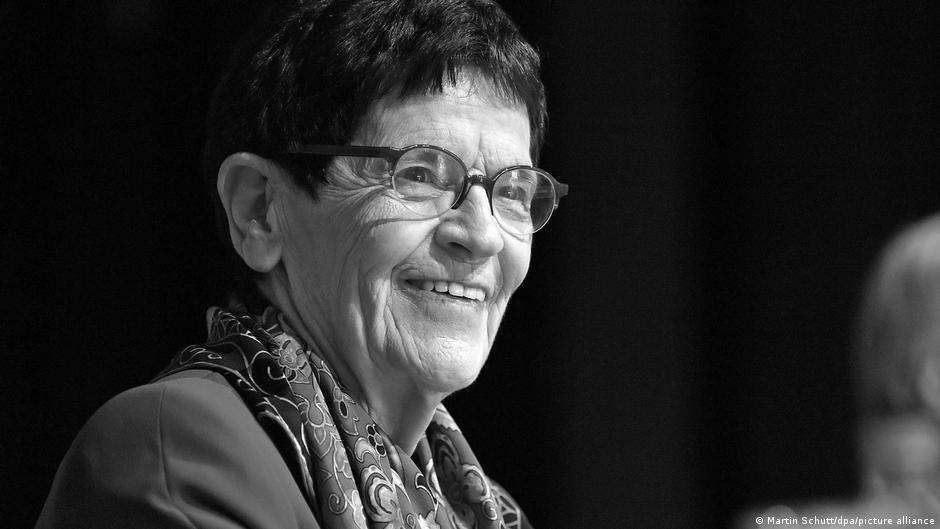

German Chancellor Friedrich Merz paid tribute to Rita Süssmuth as a “great politician” and a “guiding light for our democratic society.”
Süssmuth died on Sunday, less than two weeks before she would have turned 89.
As a federal minister and president of the German Bundestag during the 1980s and 90s, Süssmuth had been “a role model and a pioneer, not least for gender equality and the political influence of women,” Merz said.
He stressed that she’d fought for a modern and open society and set standards for tolerance and openness to the world.
Rebel against Helmut Kohl
Süssmuth was a politician who helped shape significant developments in Germany’s modern history. She passed her first political endurance test in 1989. Opposition was forming within her party, the conservative Christian Democratic Union (CDU), against Helmut Kohl, who at the time had been party chairman for 16 years and German chancellor for seven.
A group came together aiming to vote out Kohl as CDU chairman and Rita Süssmuth was among them. Despite this, Kohl was able to secure enough support and was reelected at a party conference with 77% of the delegates’ votes. Those who had conspired against him were sidelined.
Even then, one of Rita Süssmuth’s qualities was clear: her toughness. In contrast to other Kohl opponents, she withstood the conflict unharmed and remained Bundestag president until the end of the Kohl era in 1998.
Friends became opponents
But the rift persisted. Kohl viewed it as a betrayal that of all people, the woman he had originally promoted in a calculated political power-play to moderately reform the party for the future had turned against him.
Even before that, it had bothered him that Süssmuth, as minister for womens’ and family affairs, was pushing ahead with modernization all too briskly for his liking. Kohl feared that the party could become overwhelmed.
Süssmuth, on the other hand, felt let down by the chancellor in the battle against the conservative wing of the party.
Help for addicts and AIDS patients
Süssmuth was a lawmaker in the Bundestag until 2002. Born in Wuppertal in 1937, she pursued Romance studies and history in Münster, Tübingen and Paris and later also studied educational science, sociology, and psychology. She joined the CDU in 1981. Only four years later she became the federal minister for youth, family, and health (from 1986 also minister for women), even though at that point she was largely an unknown in politics.
Right from the beginning, the woman with the distinctive short hairstyle and rectangular glasses did not shy away from confrontations with the conservative forces in the bloc of the CDU and its Bavarian sister party, the Christian Social Union (CSU). To them she had the effect of a red rag to a bull. Nevertheless, she was able to achieve a lot for the issues closest to her…
Read More: Rita Süssmuth, trailblazer in German politics, dies aged 88
