
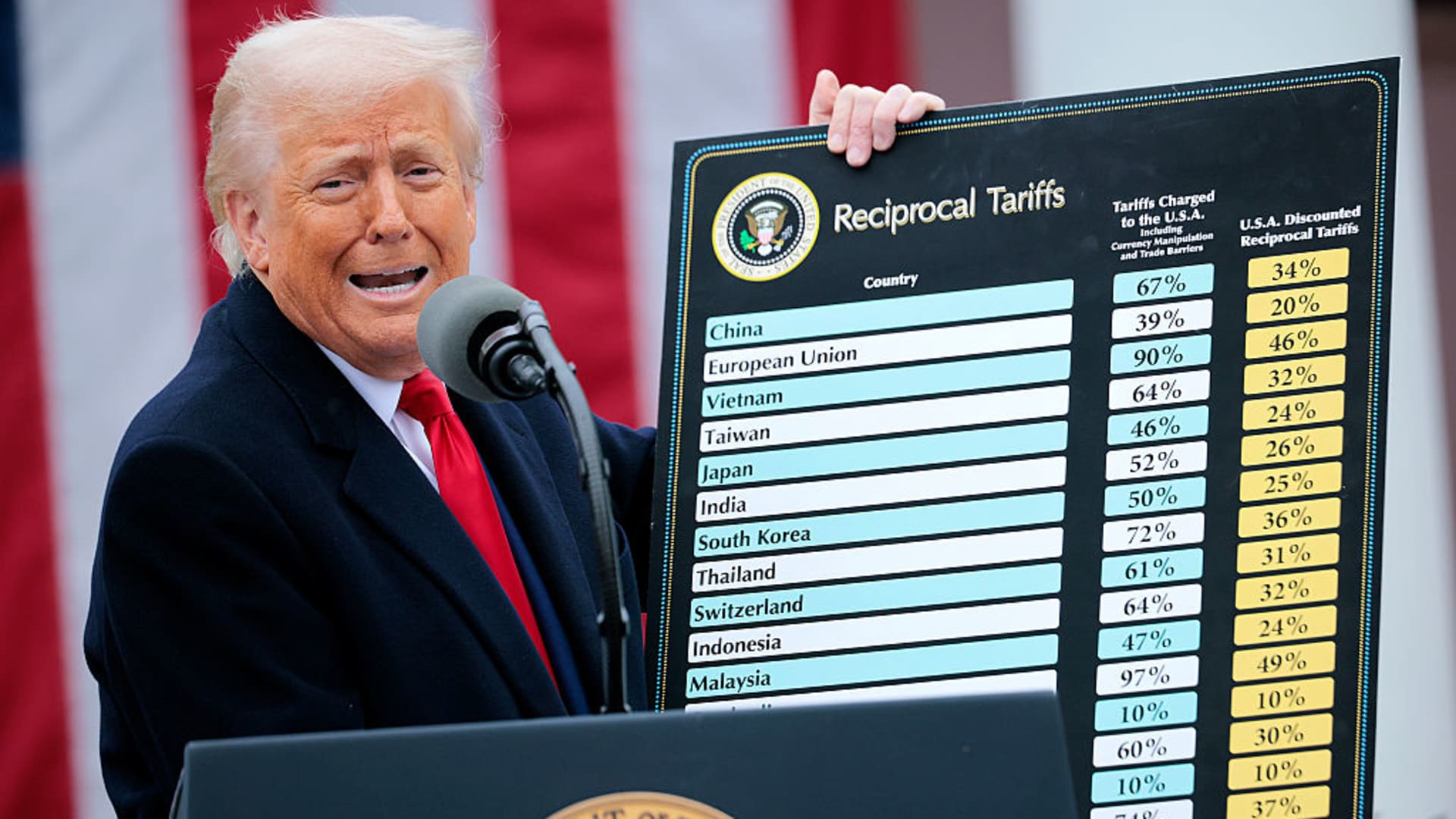

U.S. President Donald Trump holds up a chart while speaking during a “Make America Wealthy Again” trade announcement on April 2, 2025 in Washington, DC.
Chip Somodevilla | Getty Images News | Getty Images
The U.S. Court of International Trade on Wednesday blocked steep reciprocal tariffs unilaterally imposed by President Donald Trump on scores of countries in April to correct what he said were persistent trade imbalances.
The ruling deals a potentially serious blow to the Republican president’s economic agenda and ongoing efforts to negotiate trade deals with various nations.
Dow futures jumped 500 points on news of the ruling, which the Trump administration immediately appealed to the U.S. Court of Appeals for the Federal Circuit.
The Supreme Court could end up having the last say in the case.
In its ruling, a three-judge panel on the Court of International Trade said that the International Emergency Economic Powers Act, which Trump invoked to impose the tariffs, does not authorize a president to levy universal duties on imports.
“The Worldwide and Retaliatory Tariff Orders exceed any authority granted to the President by IEEPA to regulate importation by means of tariffs,” the judges wrote.
And separate, specific tariffs on Canada, Mexico, and China related to drug trafficking “fail because they do not deal with the threats set forth in those orders,” the panel wrote.
Implementing tariffs typically requires congressional approval.
But Trump chose to bypass Congress by declaring a national economic emergency under IEEPA, which became law in 1977, and then using the purported emergency as justification for cutting Congress out of the process.
The panel not only ordered a permanent halt to the tariffs at issue in the case, but it also barred any future modifications to them.
The Trump administration was given 10 days to make the necessary changes to carry out the judges’ orders.
Several existing tariffs on specific products like aluminum and steel are not impacted by Wednesday’s ruling, because the president did not invoke IEEPA powers to justify their necessity.
White House spokesperson Kush Desai, in a statement on the ruling, said, “Foreign countries’ nonreciprocal treatment of the United States has fueled America’s historic and persistent trade deficits.”
“These deficits have created a national emergency that has decimated American communities, left our workers behind, and weakened our defense industrial base – facts that the court did not dispute.”
“It is not for unelected judges to decide how to properly address a national emergency,” Desai added.
One of the lead plaintiffs in the case, Oregon Attorney General Dan Rayfield, called the ruling “a victory not just for Oregon, but for working families, small businesses, and everyday Americans.”
“President Trump’s sweeping tariffs were unlawful, reckless, and economically devastating,” Rayfield said in a statement.
“They triggered retaliatory measures, inflated prices on…
Read More: Court of International Trade strikes down Trump’s tariffs
