
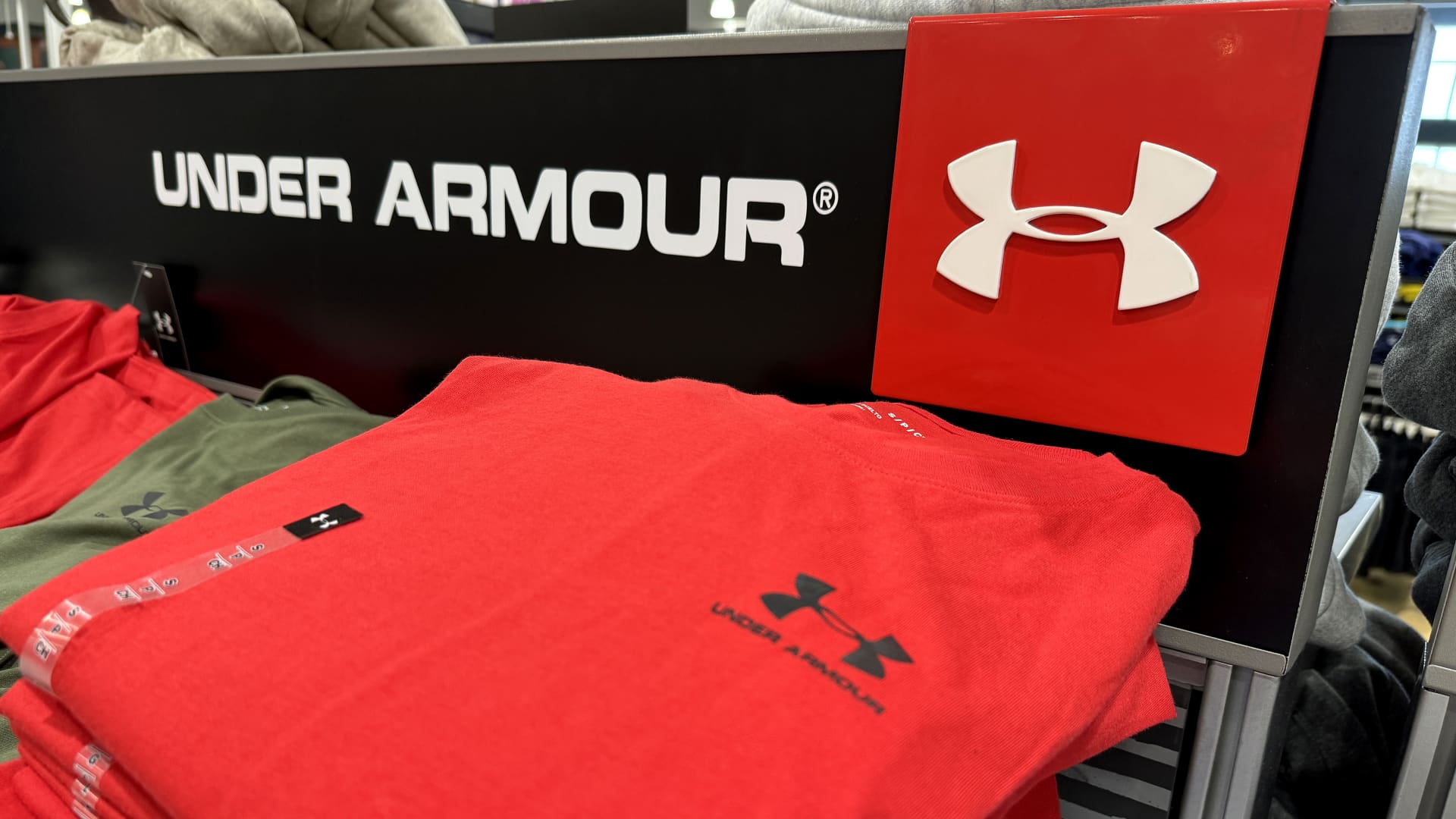

Under Armour on Thursday said sales are falling across its business, but the athletic apparel retailer posted better fiscal first-quarter results than feared, sending its stock surging in early trading.
The company beat Wall Street’s expectations on the top and bottom lines. Its shares closed nearly 20% higher Thursday.
Here’s how the athletic apparel company did in its fiscal first quarter compared with what Wall Street was anticipating, based on a survey of analysts by LSEG:
- Earnings per share: 1 cent adjusted vs. a loss of 8 cents expected
- Revenue: $1.18 billion vs. $1.15 billion expected
In the three months ended June 30, Under Armour reported a loss of $305.4 million, or 70 cents per share, compared with a profit of $10 million, or 2 cents per share, a year earlier. Excluding one-time expenses, it reported a profit of $4 million, or 1 cent per share.
Sales dropped to $1.18 billion, down about 10% from $1.32 billion a year earlier.
In late June, Under Armour agreed to settle a year-sold securities lawsuit for $434 million about three weeks before a trial was slated to begin. In 2017, Under Armour was accused of defrauding shareholders about its revenue growth in a bid to meet Wall Street’s forecasts.
In a press release, the company said it was not admitting fault or wrongdoing but had agreed to end the case – about seven years after it was filed – because of “the costs and risks inherent in litigation.” Under Armour said it would pay the settlement using cash from its revolving credit facility.
The company now expects to swing to a loss in fiscal 2025. It’s forecasting losses per share to be between 53 cents and 56 cents and adjusted earnings per share to be between 19 cents and 22 cents.
Under Armour previously expected full-year earnings of 2 cents to 5 cents per share, and adjusted earnings between 18 cents and 21 cents per share.
The athletic apparel company is in the midst of a broad restructuring plan as it fights to regain relevance, reverse a sales slump and boost profits. Earlier this year, Under Armour said it would lay off an unknown number of workers, cut back promotions and discounts, and streamline its assortment to be more competitive. It’s also looking to take a page out of Nike’s playbook and position Under Armour as a premium brand.
The restructuring came two months after former Marriott executive Stephanie Linnartz was ousted as Under Armour’s CEO and its founder Kevin Plank returned to the helm once again.
In a statement Thursday, Plank said the company is “encouraged by early progress” in its efforts. While sales still tumbled across Under Armour’s business during the quarter, results came in better than expected.
In North America, Under Armour’s largest market, sales dropped 14% to $709 million, but were higher than the $669.1 million that analysts had expected, according to StreetAccount. Wholesale revenue fell 8% to $681 million, while direct-to-consumer sales declined 12% to $480 million.
Sales at stores owned and operated…
Read More: Under Armour (UAA) earnings Q1 2025
