
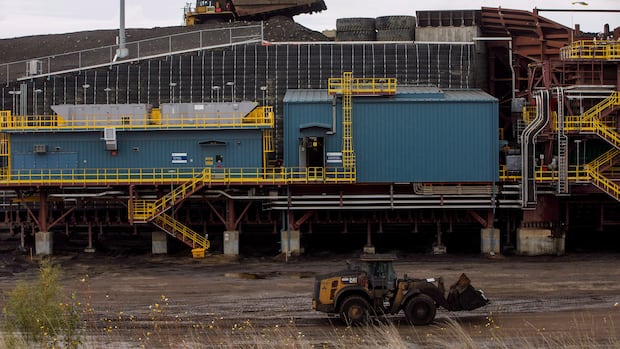

It’s been a relatively quiet decade in Alberta’s oilsands, but the federal and provincial governments believe a new West Coast pipeline coupled with policy shifts might help turn up the volume.
Prime Minister Mark Carney was in Fort McMurray, Alta., this week to announce the first proposal to be deemed in the national interest under legislation passed last year: the million-barrel-per-day Pacific Link pipeline from Alberta to a tanker export terminal in southern B.C.
The designation means the proposal will be subject to a streamlined review process, shepherded by the Calgary-based major projects office.
The pipeline’s economic fate hinges on oilsands companies being willing to spend on expanding their output. At a news conference, Carney was asked whether he expected a return to boom times in the northeastern Alberta oilsands hub city.
“I wouldn’t use the term ‘boom,”‘ he replied. “I would use ‘sustained growth.”‘

Prime Minister Mark Carney announced that the West Coast Pipeline, known as Pacific Link, will be listed as a project of national interest under the Building Canada Act, allowing the government to fast-track the approval process.
The last boom from the mid-2000s to mid-2010s came with the side-effects of cost inflation, labour scarcity and housing shortages. Carney and Alberta Premier Danielle Smith say that if oilsands companies start building again — as they hope — it will be different this time around.
Oilsands companies have for years shied away from the multibillion-dollar megaprojects of more than a decade ago. The last mine to be built from scratch was Fort Hills, operated by Suncor Energy Inc.
From when it got the final go-ahead decision in 2013 to its startup in 2018, its cost ballooned to more than $17 billion from $13.5 billion.
Lately, instead of so-called “green field” projects, companies have opted to instead tweak their existing operations to squeeze out more bitumen or add to their existing footprints.
Executives have cited a dearth of pipeline capacity, a convoluted regulatory regime and onerous environmental regulations for the chill on large-scale growth projects.
[Companies] have managed to find a way to increase production without having the kind of dramatic pressure that we saw in the past of a large number of people moving here, not able to find homes.– Danielle Smith, Alberta premier
But also around the time investment fell off a decade ago, global crude prices cratered amid a supply glut and didn’t have much of a chance to recover before the COVID-19 pandemic virtually obliterated demand.
Fast forward to 2026, and the Mideast war has laid bare the vulnerability of global energy supply chains and left countries clamouring for stable providers.
A host of Trudeau-era energy policies loathed by oilpatch players have been undone and Pacific Link has taken a big step forward to becoming a reality, potentially…
Read More: Carney, Smith say new West Coast pipeline could get oil companies building
