
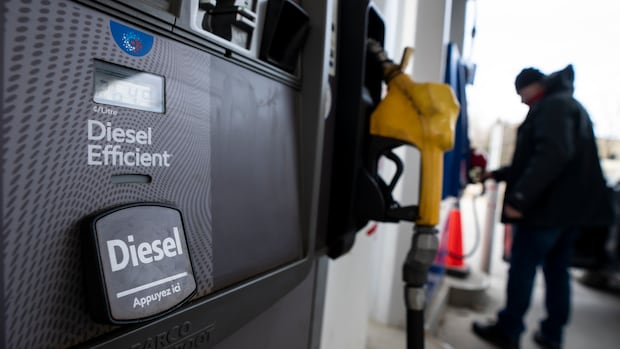

With diesel prices skyrocketing due to ongoing global conflicts, filling up the trucks that carry food and goods across Canada has never been more expensive, experts say — and Canadians could be feeling it soon.
“It’s very bad,” Tej Dulat, director of government and public affair with the Canadian Truck Operators Association, told CBC News.
A commercial truck goes through hundreds of litres every week, making fuel one of the biggest costs for trucking companies, Dulat said. And while the industry can usually absorb a brief spike in prices, he said, the margins have been tighter since prices jumped in 2022, when Russia invaded Ukraine.
Now, prices are even higher.
“End of the day, companies have to pass that cost to the consumers,” Dulat said.
“You’re going to see that impact coming on the grocery prices.”
As of Saturday prices sat at $2.62 per litre across Canada for diesel, surpassing last week’s high of $2.52 after a brief dip earlier this week. That’s more than a dollar higher than it was this time last year, according to Natural Resources Canada, and higher than the top weekly average in 2022, which came in at $2.30.
It’s worse in some regions — Vancouver sat at $2.92 per litre on Saturday. And in the U.S., the average price of diesel hit a record-high on Friday at more than $6 US per gallon, sending shockwaves across the country.
Much attention over the past few weeks has been on the potential impact of tariffs on the price of Canadian goods, but this jump in oil prices suggests that geopolitical conflicts are having a bigger impact right now, experts say.

Industries that depend on diesel fuel are also feeling the pinch of high oil prices. In Alberta, some farmers say diesel is costing them 80 cents more per litre than it did last year, and that’s cutting into their bottom line.
Bank of Canada governor Tiff Macklem said last week that while tariffs could hit some sectors hard, they don’t expect them to strongly impact Canada’s overall level of economic activity.
But the ongoing U.S.-Israel war with Iran, which is the main driver keeping gas prices high, could mean a spillover in cost from gas to other goods shortly, he said.
“The longer oil prices and refinery prices stay high, the greater the risk that higher energy prices spill over and turn into persistent inflation.”
Not enough supply
The problem is that diesel is in extraordinarily short supply, experts say. Net exports of diesel/gasoil from the Persian Gulf region had dropped to just over a quarter of pre-war levels as of August, according to a report published Friday by the International Energy Association.
Meanwhile, other geopolitical stressors are also putting strain on the amount of diesel available. One of the world’s biggest producers, Russia, recently extended a ban on diesel exports after Ukraine damaged a number of oil refineries.
Canada’s largest…
Read More: The price of diesel is skyrocketing. Here’s why Canadians may soon feel it
