
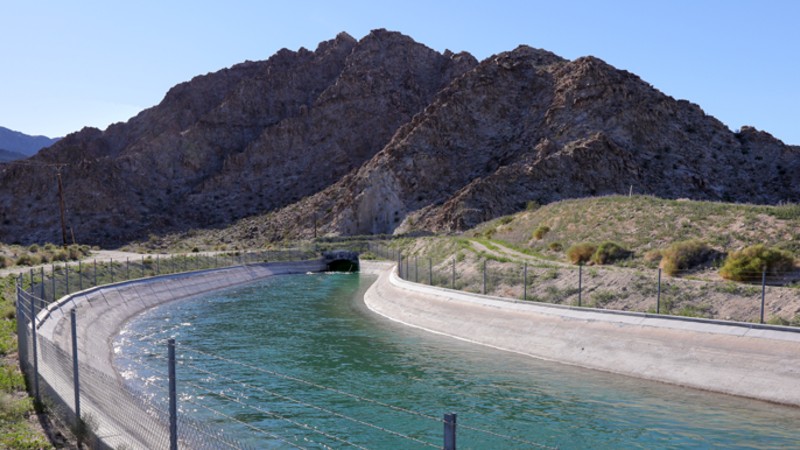


The Department of the Interior last month announced Colorado River supply cuts affecting the basin states of Arizona, Nevada and California, leaving many communities bracing for reduced water access. San Diego, though, says decades of costly investments — some criticized for driving up water bills — have positioned the region to avoid the pain other Southwest communities now face.
For decades county water agencies have invested in water resources and procurement — securing independence from a cut from any one source, sometimes at a steep price.
“Over the last 30 plus years, we have been developing and investing in new and alternative water supplies and rights for the San Diego region,” said Jeremy Crutchfield, the water resources manager for San Diego County Water Authority. “We are at a point now where we have abundant water supply and we can meet the demands of this region even during dry drought periods, even extended drought periods. We have access to enough water to meet our demands, so we’re in a very unique spot compared to the rest of California, Southern California and the Southwest in general.”
The plan, by the Department of the Interior, sets operating guidelines for how water is released from Lake Powell and how Colorado River water is shared for the next two years.
The guidelines require the lower basin states — Arizona, Nevada and California — reduce their Colorado River water consumption by a total of 1.25 million acre-feet per year — one acre-foot of water is enough to cover one acre of land to a depth of one foot.
California will reduce its use by 440,000 acre-feet, an amount roughly equivalent to the annual water needs of 1.5 million households.
But Crutchfield said San Diego water customers won’t notice a difference, despite the cuts.
“The way that our agreements are structured, we do have a senior right to the water,” he said. “So, we aren’t part of the first cuts of California. One of our investments in the region was increasing our reservoir storage … if we were to see those cutbacks, that would just be mitigated through our reserve water supply that we have in storage.”
The river water cuts are intended to keep Lake Powell and Lake Mead’s water levels high enough to ensure the Glen Canyon Dam and the Hoover Dam can continue to operate regularly.
Jennifer Pitt, the director of the Colorado River Program at the National Audubon Society, said the adopted management framework provided some relief and forward-looking optimism.
“Climate change is water change,” she said. “We cannot know exactly what is needed for the future, but it’s really important that we have rules in place that prepare us for a shift to a much drier hydrology on the Colorado River.”
One of San Diego’s key water wins was the landmark 2003 “quantification settlement…
Read More: San Diego is touting its water plan as Colorado River cuts arrive
