
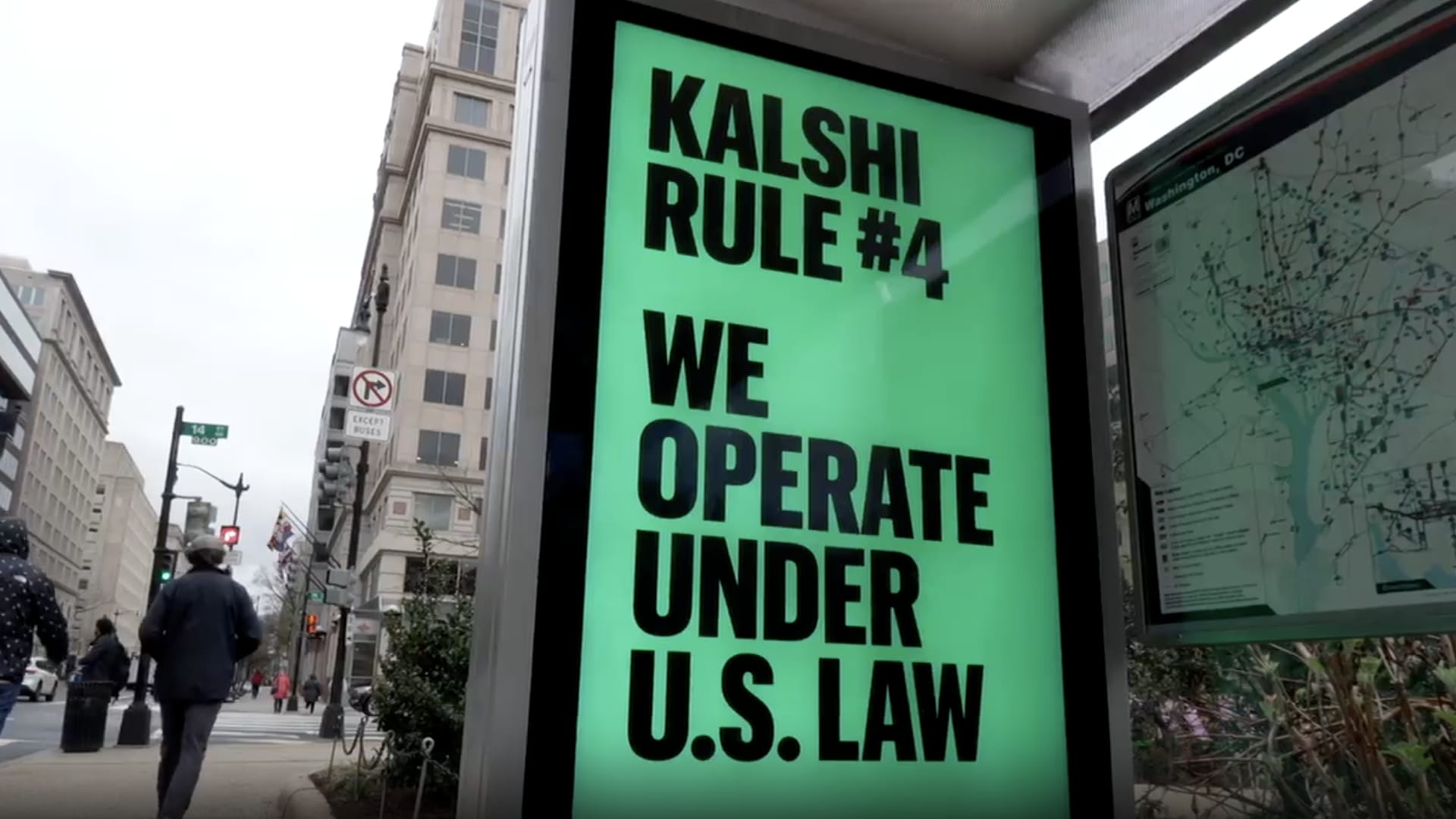

A Kalshi advertisement seen in Washington on March 27, 2026.
Paul Lester | CNBC
The 9th U.S. Circuit Court of Appeals rejected prediction market platforms’ requests for injunctive relief against the Nevada Gaming Control Board, concluding that sports-related event contracts are not a derivative regulated by the federal government.
The court rejected appeals by Kalshi and Crypto.com, two prediction market platforms, to stop Nevada from halting their operations which the state claims are gambling offerings outside of the gaming control board’s framework. The court also ruled against Robinhood’s request for injunctive relief. That firm also features event contracts on its trading platform.
Under scrutiny were the platforms’ sports-related event contract offerings, which 44 states argue are nothing more than sports betting. However, the platforms — and their federal regulator, the Commodity Futures Trading Commission — claim all event contracts, no matter the topic, are swaps. Swaps are a type of derivative under the purview of the CFTC, and the agency asserts that it has the exclusive jurisdiction to regulate all event contracts.
The CFTC has even sued nine states to defend what it believes is its sole right to make rules for prediction markets.
But the 9th Circuit rejected that argument. “The sports event contracts were not ‘swaps’ because they were sports bets,” the court said in its opinion against Kalshi.
The Nevada Attorney General’s office said the ruling was a major victory.
“Kalshi sought to sidestep Nevada’s gaming laws by claiming its sports wagering products were federally regulated financial instruments beyond the reach of state regulators,” deputy communications director for the office Alcinia Whiters said in a statement. “The Ninth Circuit rejected that argument and made clear what we have maintained from the beginning: sports betting does not become something else simply because a company calls it an ‘event contract’ … Our office is proud to have defended Nevada’s authority.”
In a statement to CNBC, a CFTC spokesperson said that the court understood that swaps are exclusively regulated by the commission, but said it was wrong to believe that sports-related event contracts don’t fall under that definition.
“A derivative contract structured as a swap is a swap regardless of the underlying subject matter — the only exceptions in statute are onions and movie box office receipts,” the spokesperson said in a statement. “The Ninth Circuit erred today when it invented a new and atextual exception to the CEA,” referring to the Commodity Exchange Act, the law that details which event contracts the CFTC is allowed to permit and reject.
Legal experts have widely expected that the question of sports-related event contracts, and whether state gaming regulators or the CFTC has the right to regulate them, will eventually reach the Supreme Court.
That now appears very likely, as the ninth circuit’s decision contradicts a ruling from the
Read More: Appeals court rules against prediction markets, tees up SCOTUS fight
