
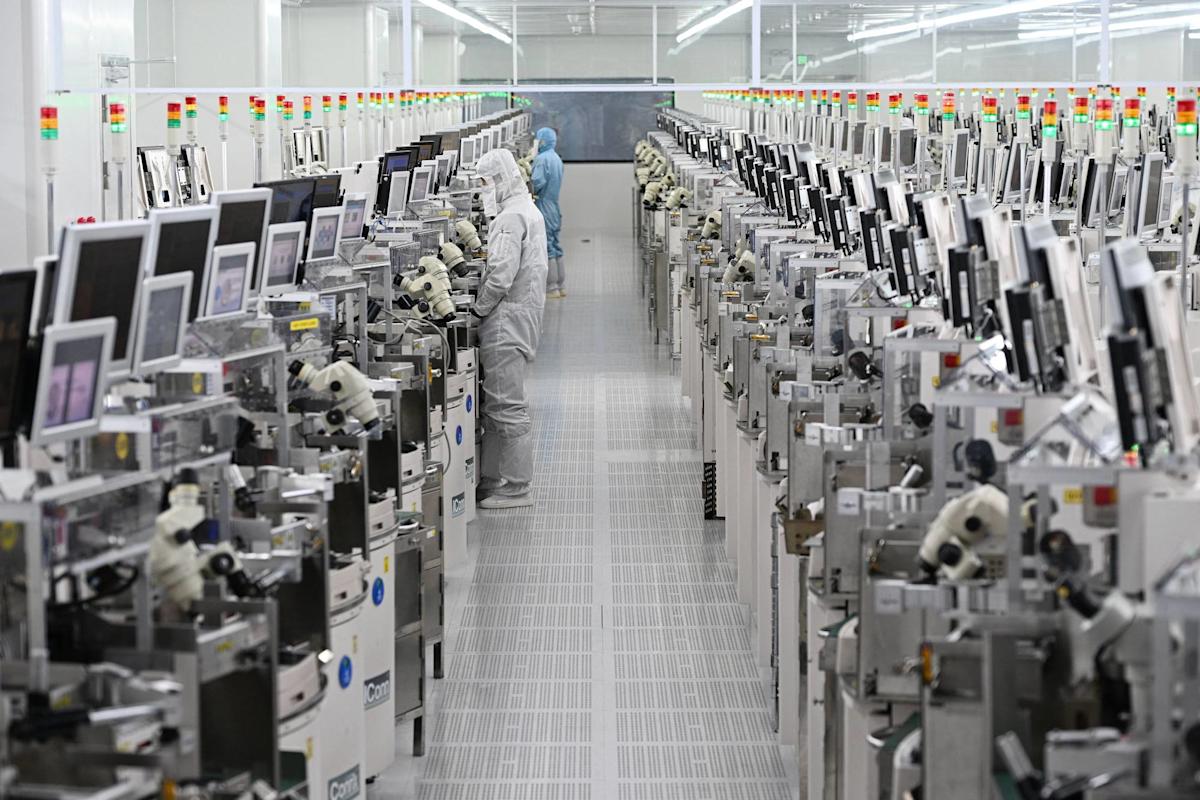

The use of chips for artificial intelligence and electric vehicles (EVs) will offer strong demand underpinning the development of mainland China’s semiconductor industry, according to veterans of the sector at an annual gathering in Shanghai.
At the 2025 Global Semiconductor Market Summit, chip executives discussed the industry’s future amid US-China tech rivalry and surging demand for chips, as well as different technology trajectories. The two-day event, which wrapped up on Friday, was organised by the World Integrated Circuit Association.
AI chips, memory chips and automotive chips have become the main drivers of growth for the domestic chip-design sector thanks to the global AI frenzy and China’s booming EV industry, said Wu Jian, vice secretary general of Jiangsu Semiconductor Industry Association, at the event.
Do you have questions about the biggest topics and trends from around the world? Get the answers with SCMP Knowledge, our new platform of curated content with explainers, FAQs, analyses and infographics brought to you by our award-winning team.
Jiangsu, the eastern province next to Shanghai, is a key base for the country’s semiconductor design and production facilities. Wu said the key chokepoint for China’s advanced chipmaking industry was a scattered chip-production pattern.
While China had around 189 production lines to process wafers, the combined capacity was just over 6 million wafers per month, with the average capacity per line trailing far behind advanced global players such as Taiwan Semiconductor Manufacturing Co (TSMC) and SK Hynix, Wu said.
According to China’s statistics bureau, the country’s total output of integrated circuits (ICs) expanded 10.2 per cent in the first 10 months of 2025 to 386.6 billion units. In October alone, the output expanded 17.7 per cent from a year earlier to 41.8 billion units. Meanwhile, China imported 493.8 billion ICs in the first 10 months, an increase of 8.5 per cent from a year earlier, according to customs data.
As China is denied access to the most advanced chips from Nvidia and the advanced fabs run by TSMC, the country is betting on a new chip structure, namely RISC-V, to empower its chip industry.
With the surge in AI applications, RISC-V chips are expected to become the main workhorse in operating systems for large language models (LLMs), said Liu Shuai, chief marketing officer at Beijing Eswin Computing Technology, which focuses on the design of RISC-V chips, at the forum on Friday.
Liu said RISC-V chips were the “best choice for the AI era”, thanks to their high power efficiency. He predicted RISC-V would become the “mainstream chip architecture” over the next three to five years, with wide adoption in data centres and smart devices.

Read More: China’s chip leaders bank on AI, EVs, RISC-V as industry’s future growth
