

Hong Kong
CNN
—
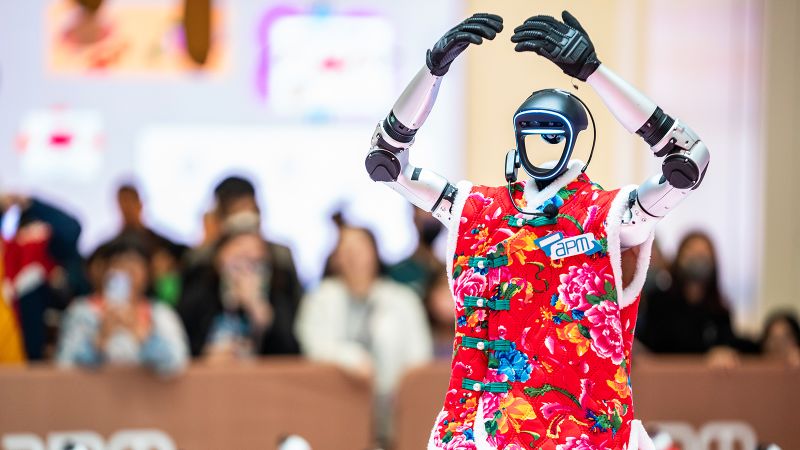
Spinning bright red handkerchiefs and dancing in step to folk music, more than a dozen human-like robots took to China’s biggest stage in January, making a splashy debut at the annual Lunar New Year gala.
The remarkable performance, watched by more than a billion people, is a high-profile reminder of how far Chinese humanoid robots have come. Over the past two months, videos of the country’s humanoid robots pulling off moves such as bike rides, roundhouse kicks and side flips have blown up the internet, often amplified by state media as a key potential driver of economic growth.
Even though very few of the humanoids are in mass production, competition with Elon Musk’s Tesla, one of the acknowledged frontrunners in the field, is heating up. The promise of an “I, Robot” future, where machines handle household chores and serve as caregivers, has drawn nearly every major tech company in both the United States and China to bet on humanoids or robotics.
Microsoft, Nvidia and Amazon founder Jeff Bezos have invested in American humanoid maker Figure AI. Meanwhile, Meta is planning major investments in humanoids, according to a Bloomberg report last month.
Musk, whose Optimus humanoid has sparked global interest since its debut in 2022, predicted last month that the project alone could generate more than $10 trillion in revenue.
While it may take another five to 10 years for humanoid robots to make a real societal impact, they could eventually become the next widely adopted consumer electronics, according to Xi Ning, chair professor of robotics and automation at the University of Hong Kong.
“Everybody will need them, like automobiles, like cellphones, and the potential market volume will be huge,” he told CNN.
Goldman Sachs projected last year that the global humanoid robot market will be worth $38 billion by 2035. In five years, they estimate that 250,000 humanoid units, mainly for industrial use, will be shipped, while consumers will be buying about one million units a year in about a decade.
Beijing, which is looking to replicate China’s success in the electric vehicle (EV) market, wants to be at the forefront of that growth.
It’s eager to position the country as a global tech powerhouse and build on the momentum of recent Chinese achievements in the field – such as AI startup DeepSeek’s reasoning model that stunned the world in January – especially as the US tightens tech restrictions on Beijing.
Despite entering the race later than American rivals including Tesla, Boston Dynamics and Figure AI, experts say Chinese firms are rapidly closing the gap. With their preternatural ability to optimize supply chains and…
Read More: Elon Musk thinks robots are a $10 trillion business but China is catching
