
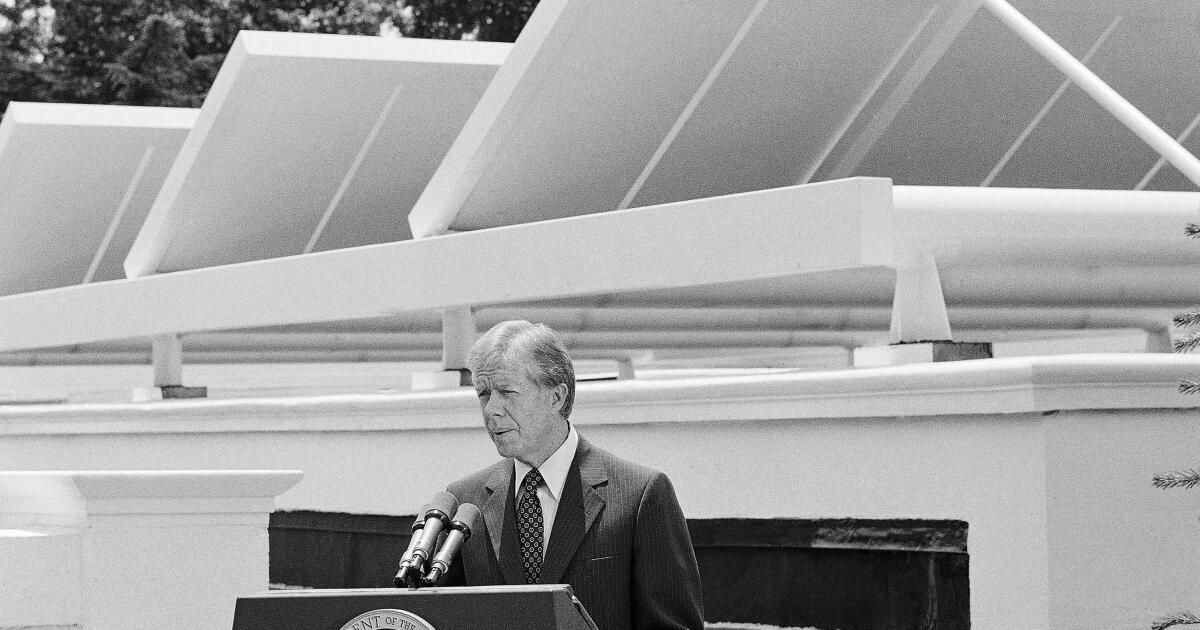

In the renewable energy arena, Jimmy Carter is perhaps best known for having solar panels installed on the roof of the White House — panels that were later removed by his successor, Ronald Reagan.
But the 39th president, who left office in 1981 and died Sunday at age 100, had grander visions for a sustainable planet. If the U.S. had acted on them, we might face a less calamitous climate future than we do today.
Carter cared deeply about the natural world. As president, he doubled the size of the national park system and tripled the amount of federally protected wilderness. He signed the Superfund law, which created a way for the government to fund hazardous waste cleanups. He tried and largely failed to block construction of more than a dozen expensive, environmentally destructive water infrastructure projects such as dams, canals and reservoirs.
He also tried to reduce U.S. dependence on foreign oil, implementing the first vehicle fuel-efficiency standards and tasking researchers with bringing down the cost of solar panels — an effort he predicted could be “a small part of one of the greatest and most exciting adventures ever undertaken by the American people.”
“Nobody can embargo sunlight,” Carter said in 1978 at the federally funded Solar Energy Research Institute in Golden, Colo., the predecessor to today’s National Renewable Energy Laboratory. “No cartel controls the sun. Its energy will not run out. It will not pollute the air; it will not poison our waters. It’s free from stench and smog.”
Prophetic words. And although he was largely thinking about how to free Americans from geopolitical crises that could wreak havoc on oil supplies and gasoline prices, he also had heat-trapping greenhouse gases in mind.
Soon after taking office, he ordered an ambitious study of “probable changes in the world’s population, natural resources, and environment.” The final report from the White House Council on Environmental Quality warned that fossil fuel combustion could cause “widespread and pervasive changes in global climatic, economic, social, and agricultural patterns.” It advised that to avoid such risks, we should limit global temperature increases to 2 degrees Celsius above preindustrial levels — the goal eventually agreed to by nearly 200 nations, 35 years later.
Even if Carter’s actions were targeted more at reducing oil imports than at cutting planet-warming pollution — he was willing to increase domestic coal production if it meant less dependence on foreign crude — the political battles he fought, particularly those he lost, have lessons for those of us who care about the climate today.
The historian Kai Bird, for instance, notes that after struggling to pass a tax on gas-guzzling cars, Carter wrote in his diary, “The influence of the oil and gas industry is unbelievable, and it’s impossible to arouse the public to protect themselves.” Indeed, oil and gas companies still wield huge influence. SUVs are
Read More: Jimmy Carter tried to fix the planet. The oil industry fought back
