



The Commercial Real Estate Momentum Index (CREMI) provides easy access to various metrics for individual markets by sector and facilitates comparisons of conditions across markets. The index tracks movements in specific metrics (such as occupancy/vacancy rate, rent growth, and the construction pipeline) and provides a targeted view of real estate conditions in the industrial, multifamily, office, and retail sectors. Additional metrics, including employment and population growth, provide information specific to each sector as appropriate. CREMI derives a momentum index value for each sector within a market and gives an overall momentum index value for the entire market. Upward and downward momentum correspond with aggregated trends in the market metrics, not necessarily indicating “good” or “bad.”
Be sure to explore the tool’s newest feature under the U.S. Map tab. In addition to selecting a property type to view, users can select a specific variable to explore a national snapshot of variable trends. Also, on the Bell Curve view, hovering over a particular market will show the market’s momentum index breakdown, allowing users to explore what’s driving the property type index alongside other markets.
Every month we explore another aspect of the Commercial Real Estate Momentum Index (CREMI) and how it can inform us about commercial real estate conditions. This month we’ll explore dynamics that have allowed the industrial sector to remain balanced despite the past year’s economic hardships. Variables that create the industrial momentum index include vacancy rates, vacancy trends, rent growth, construction forecasts, nonstore retail sales growth, and employment growth in transportation and warehousing.
National industrial sector overview
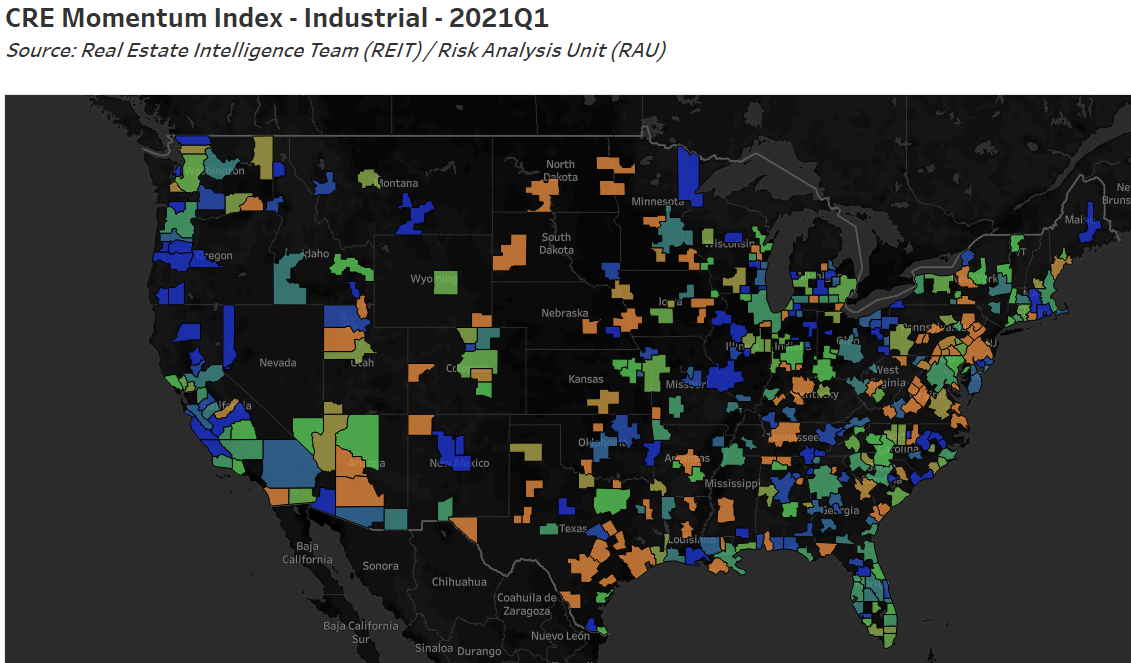
Industrial sector data for the first quarter of 2021 does not immediately reflect distinct trends in sector dynamics across the United States. The 390 markets tracked in CREMI are quite evenly distributed across the momentum index spectrum (see the chart). We further explore conditions in the industrial sector to tease out other national tendencies or similarities in the underlying variables.

Industrial markets maintain strong vacancy rates…but risk is growing
U.S. industrial space continues to be in high demand. For the past five years, more than half of the CREMI markets experienced industrial vacancy rates below long-term norms. Per CREMI’s methodology, long-term averages span 20 years of historical data, relative to each market, property type, and variable. As of the first quarter of 2021, 294 markets (75 percent) had vacancy rates below long-term norms and contributed to a very hot property segment. However, the trend has been moderating somewhat compared to levels…
Read More: Commercial Real Estate Update: Industrial Sector Robust, but Risk Is
