

Alberta has formally proposed an oil pipeline to the southwest coast of British Columbia for tanker export to Asian markets, in partnership with federally-owned Trans Mountain Corp. and Calgary-based Pembina Pipeline Corp. acting as the private proponent.
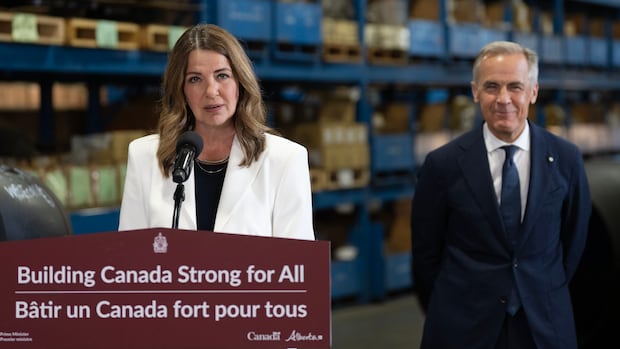
Premier Danielle Smith announced the province’s submission to the federal Major Projects Office in Calgary in a joint press conference with Prime Minister Mark Carney on Thursday evening.
The estimated cost of the project, according to the Alberta government’s submission, would be $35.2 billion to $43.7 billion, including contingencies. It expects the approximately 1,200- to 1,250-kilometre pipeline project to be completed between 2032 and 2034.
Despite long suggesting a possible northern route for the new bitumen pipeline, the two main routing options proposed will run between Bruderheim, Alta., northeast of Edmonton, to Roberts Bank Terminal in Delta, B.C., using a similar corridor to the existing Trans Mountain pipeline. One route is referred to as the “original corridor” in the submission, while the other is called the “optimized corridor.”
For the “original corridor,” roughly 92 per cent of the route would be within 100 metres of existing infrastructure or land that’s already been “disturbed.” For the optimized option, that number drops to 82 per cent.

“We’ve agreed … that the best route for a new pipeline is one that goes through one that already exists south through the Trans Mountain Corridor to our Pacific Coast, the gateway to the world’s fastest growing markets,” Carney said.
Smith said the southern route had key advantages given that it would be roughly along an existing pipeline route, including established relationships with Indigenous communities and less time to get oil to market.
“The West Coast oil pipeline will transport more than one million barrels of oil per day to Canada’s West Coast and strengthen access to growing Asian markets, helping to meet Alberta’s goal to double oil production to eight million barrels per day over the next 10 to 15 years.”

Prime Minister Mark Carney and Alberta Premier Danielle Smith discuss details of the proposed 1 million-barrel-a-day pipeline to B.C.
The announcement comes the same day Ottawa signed a multibillion-dollar memorandum of understanding with British Columbia, which included a commitment from the federal government to keep the North Coast oil tanker ban in place.
The moratorium has prohibited oil tanker traffic off the waters of northern British Columbia for years in order to protect environmentally sensitive coastlines.
The Alberta government said it chose to propose a path near the Trans Mountain pipeline to limit “new land disturbance and impacts on…
Read More: Alberta pitches southern route for West Coast pipeline, with a price tag of
