
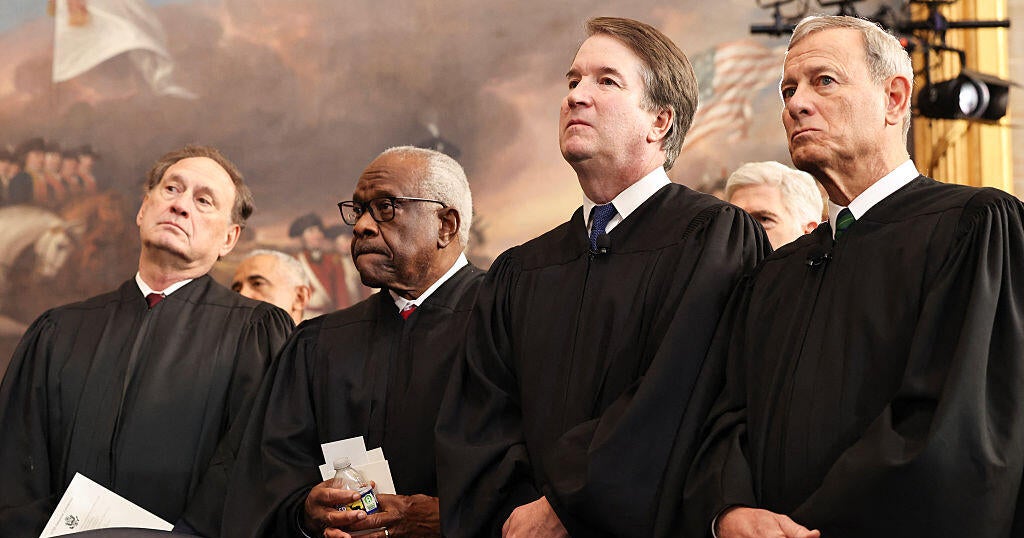

Washington — The Supreme Court issued the final rulings of its 2025-2026 term on Tuesday, capping a consequential series of decisions that addressed some of President Trump’s signature policies.
The court handed the president wins and losses on issues ranging from birthright citizenship to his ability to fire executive branch officials. Taken as a whole, the court’s moves cemented Mr. Trump’s authority over vast parts of the federal government, while delivering significant setbacks to his agenda in other areas.
The decisions against the president crossed ideological lines, with the court’s three liberal justices joining members of its conservative wing to reach majorities.
Here’s how the court’s rulings broke down:
In Trump’s favor
Firing federal independent agency officials
The Supreme Court’s conservative majority struck down removal restrictions for members of the Federal Trade Commission and overruled a 91-year-old decision that allowed Congress to shield members of many independent agencies from being fired at will.
The decision in the case Trump v. Slaughter expands the president’s power over independent boards and commissions, which Congress had insulated from political pressures by limiting the reasons for their removal.
Roberts authored the opinion for the 6 to 3 majority and was joined by the five other members of the court’s conservative wing.
“Although it is up to the Senate to decide whether to confirm those with whom the President would prefer to work, neither Congress nor the courts may saddle him with those with whom he cannot work,” he wrote. “Subordinates who exercise the President’s power are subject to removal by him. Then, and only then, can they remain accountable to the President, and the President to the people.”
Weakening the Voting Rights Act
In a landmark voting rights decision, the Supreme Court in April struck down a Louisiana congressional map that consisted of two majority-Black districts and weakened a key provision of the Voting Rights Act, Section 2.
In an opinion authored by Justice Samuel Alito in Louisiana v. Callais, the court’s conservative majority ruled that compliance with Section 2 could not justify Louisiana’s use of race in redrawing its congressional map. The Supreme Court said in order to successfully challenge House lines under Section 2, plaintiffs must put forth evidence showing a “strong inference” that the state intentionally drew districts to deprive minority voters of the opportunity to elect their preferred candidates.
The three liberal justices dissented, with Justice Elena Kagan warning that “under the Court’s new view of Section 2, a State can, without legal consequence, systematically dilute minority citizens’ voting power.”
The ramifications from the Supreme Court’s decision were swift. Several states in the South moved to recraft their House maps to reconfigure districts with majority-minority populations, which were represented by Democrats.
Read More: How the Supreme Court ruled on Trump’s agenda: Birthright citizenship,
