
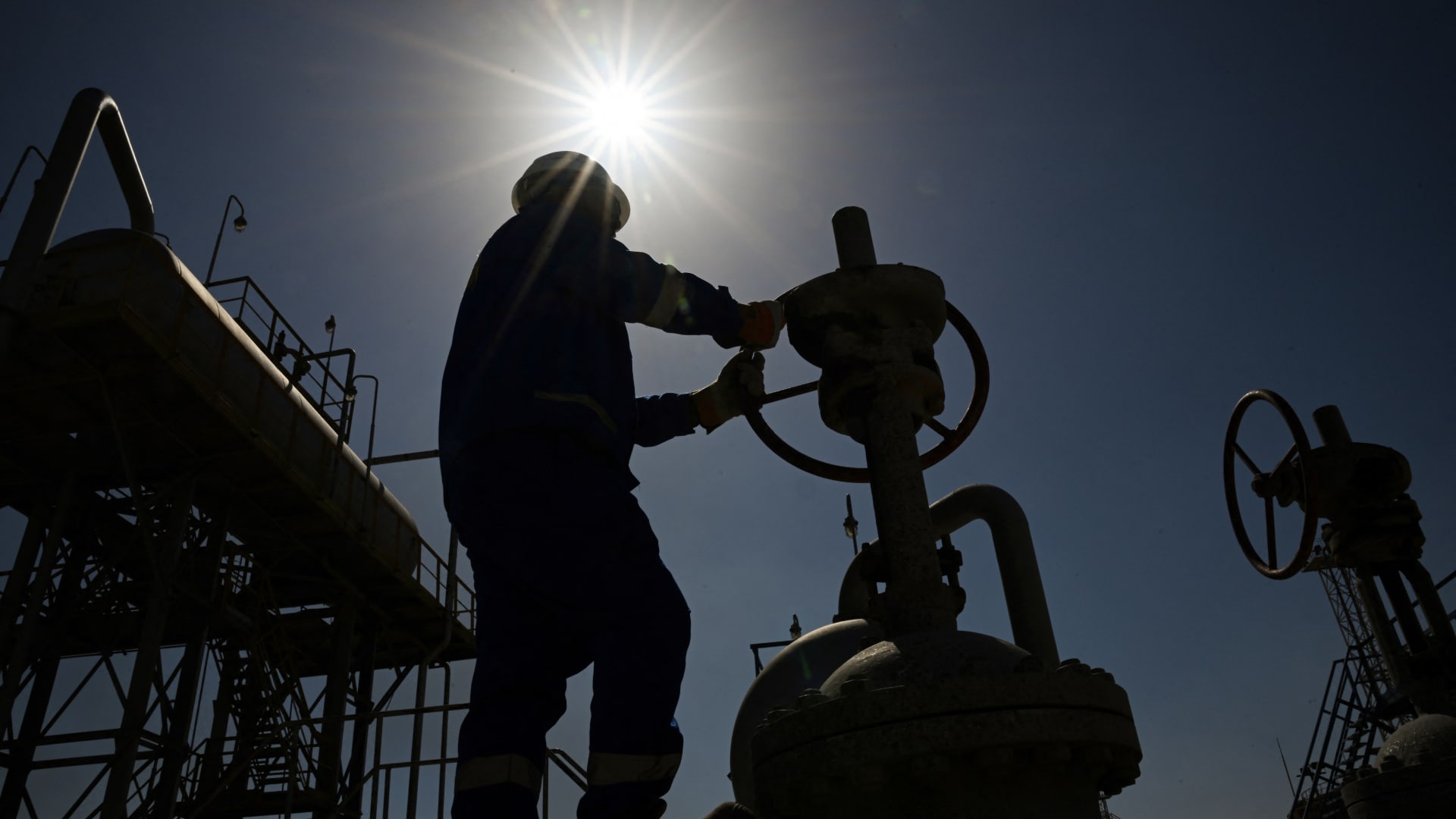

An employee of Basra Oil Company, works at the Nahr Bin Umar Oil and Gas Field on the outskirts of the southern Iraqi city of Basra on April 29, 2026.
Hussein Faleh | Afp | Getty Images
Oil prices rose slightly Thursday after President Donald Trump threatend to take Iran’s Kharg Island and assume total control of the country’s oil and gas markets.
U.S. crude oil futures rose 0.72% to $90.68 per barrel by 8:32 a.m. ET. Brent futures, the international benchmark, were up 0.48% to $93.56.
Trump said the U.S. would hit Iran very hard Thursday night after completing a round of airstrikes Wednesday against its surveillance capabilities, communication systems and air defense sites.
The president threatened to take Iran’s Kharg Island, the country’s main oil export terminal, “at some point in the not too distant future.” The U.S. will seize “total control” of Iran’s oil and gas markets like Washington did in Venezuela, Trump said in a Truth Social post.
Trump has escalated military pressure on Iran this week as he has grown frustrated with Tehran for not agreeing to a deal to open the Strait of Hormuz and abandon its nuclear program. He accused the Islamic Republic of shooting down an Apache helicopter in Hormuz earlier this week.
Oil prices jumped earlier Thursday as U.S. launched its latest round of strikes against Iran. Prices then briefly turned negative after U.S. Central Command said it had completed the strikes, raising hopes among investors that the situation might not escalate further.
Iran’s state-run Tasnim news agency said Tehran had struck several U.S. military facilities in Kuwait and Bahrain, including Ali Salem and Ahmad al-Jaber air bases in Kuwait and Sheikh Issa air base in Bahrain. Bahraini authorities said their air defense systems had intercepted and destroyed Iranian aerial threats.
Iranian state media said Tehran had carried out missile and drone attacks against U.S. vessels operating in the Strait of Hormuz. Kuwait shut its airspace and intercepted projectiles on Thursday, while Israel warned of launches from Lebanon toward communities in the country’s north.
Despite a fresh escalation in the U.S.-Iran conflict, Rystad Energy said Thursday that the oil market was better-positioned to absorb disruptions than in past crises, citing record U.S. crude exports, softer Chinese demand and alternative export routes that reduce reliance on the Strait of Hormuz.
The consultancy’s senior vice president Jorge Leon, however, warned that the chances of a near-term diplomatic breakthrough have diminished, leaving oil prices vulnerable to sharp swings as investors assess whether the latest hostilities will remain contained or evolve into a more prolonged conflict.
Read More: U.S. launches fresh strikes on Iran
