
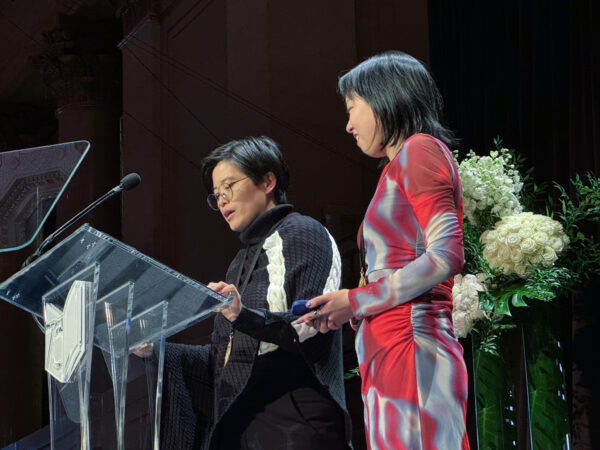

“Taiwan Travelogue” made history in late May as the first Taiwanese literary work to win the International Booker Prize. This also made the novel the first Mandarin-language novel to win the International Booker Prize in translation.
This was not the first major win for “Taiwan Travelogue.” Previously, in 2024, author Yang Shang-zi and translator Lin King had won the U.S. National Book Award for Translated Literature. This makes “Taiwan Travelogue” the first novel to win both the U.S. National Book Award and the International Booker Prize.
“Taiwan Travelogue” dovetails with many of the themes that have resonated strongly in Taiwan’s cultural representation abroad. The novel is set during the Japanese colonial period and focuses on the relationship between two women, Japanese author Aoyama Chizuko and her Taiwanese interpreter, Chi-chan. The subtext is that Chizuko is in love with Chi-chan, but their relationship is not that of equals, but rather of colonizer and colonized subject.
The Japanese colonial period, as well as Taiwan’s White Terror, have been recurring themes in contemporary Taiwanese cultural production. In a way, this is part of Taiwan’s grappling with its own contemporary identity, understood as having pluralistic influences ranging from Indigenous culture, Han settlement during the Ming and Qing dynasties, the Japanese colonial period, and the KMT’s retreat to Taiwan after the Chinese Civil War.
But, importantly, the 50-year Japanese colonial period is a way in which Taiwan’s contemporary history deviates sharply from that of the Chinese mainland through the course of the 20th century. Yang has, in comments, said that she hopes Chinese readers can come to understand how Taiwan’s history deviates from China as well as Taiwan’s complicated feelings toward Japan – a former colonizer, but one that is often romanticized. In line with this theme, “Taiwan Travelogue” depicts itself not as a fictional work, but as a recently discovered historical text – except with subtle suggestions that it may be a contemporary invention masquerading as a historical work, hence the many anachronisms.
The same-sex romance within “Taiwan Travelogue” also fits in Taiwan’s cultural zeitgeist. Particularly after Taiwan became the first country in Asia to legalize same-sex marriage in 2019, Taiwanese queer cinema and literature have loomed large internationally. Classic works, such as the films of Tsai Ming-liang, Ang Lee, or the novels of Qiu Miaojin, received new attention, as did newer documentary and film works, such as the documentary “Small Talk,” about the filmmaker’s relationship with her emotionally distant lesbian mother, or “Dear Ex,” which depicts a son who learns that his recently deceased father was gay. In another vein, Taiwanese drag queen Nymphia Wind became the first Asian winner of RuPaul’s Drag Race in 2024.
“Taiwan Travelogue” has been understood as a win for…
Read More: The Politics Behind Taiwan’s Soft Power – The Diplomat
