
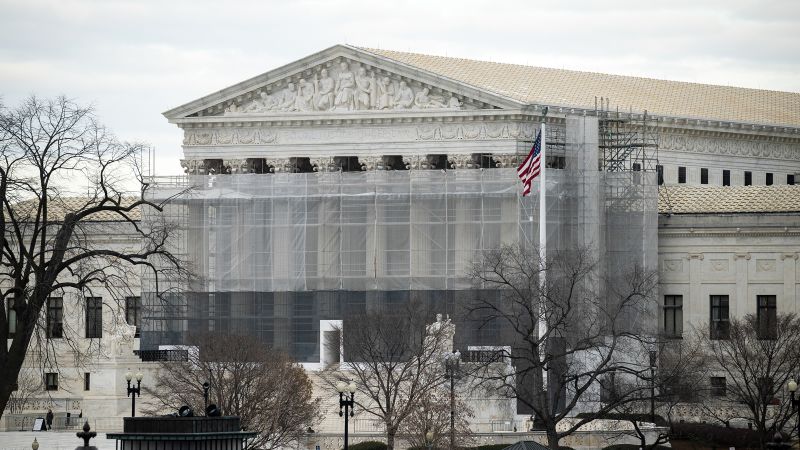

The Supreme Court on Wednesday backed a Republican congressman from Illinois who is challenging a state law that allows mail ballots to be received after Election Day, a decision that may make it easier for other candidates to challenge voting laws – even if they ultimately win their election.
The decision, written by Chief Justice John Roberts, was 7-2 with two of the court’s liberals dissenting.
“Candidates have a concrete and particularized interest in the rules that govern the counting of votes in their elections, regardless whether those rules harm their electoral prospects or increase the cost of their campaigns,” Roberts wrote. “Their interest extends to the integrity of the election—and the democratic process by which they earn or lose the support of the people they seek to represent.”
The congressman, Michael Bost, challenged an Illinois law that allows ballots to be received up to two weeks after Election Day, as long as they are postmarked by the election. Bost sued in 2022, claiming that the Illinois law ran afoul of a federal law that sets a uniform day for federal elections.
Bost did not raise claims of fraud at the Supreme Court, but President Donald Trump repeatedly railed against the expansion of mail-in ballots during the Covid-19 pandemic, falsely blaming his 2020 election loss on those policies. Illinois changed its law long before the pandemic, in 2005.
“Today’s ruling could open the door to a lot of litigation—and potential chaos – on the far side of the next contested election,” said Steve Vladeck, CNN Supreme Court analyst and professor at Georgetown University Law Center.
“If candidates will generally have standing to challenge how votes are counted in any election they’re running in, that could dramatically expand the horizon of legal challenges that can be brought challenging even those elections that were completely by the book,” Vladeck said, “potentially injecting more uncertainty in those critical days and weeks after Election Day going forward.”
The congressman’s lawsuit was effectively thrown out before it began because, a federal trial court ruled, he did not have standing to sue.
Plaintiffs must demonstrate a “concrete” and “particularized” injury before their suit may move forward in federal court. Lower courts found that Bost – who won reelection in 2022 with more than 75% of the vote – failed to meet that burden and so his case was dismissed.
Bost argued that candidates should have a kind of default standing to sue over election laws affecting their own races. At the very least, he added, the state’s ballot law required him to keep staff on the payroll weeks after Election Day to monitor the counting at…
Read More: Supreme Court revives GOP congressman’s absentee ballot suit that could
