
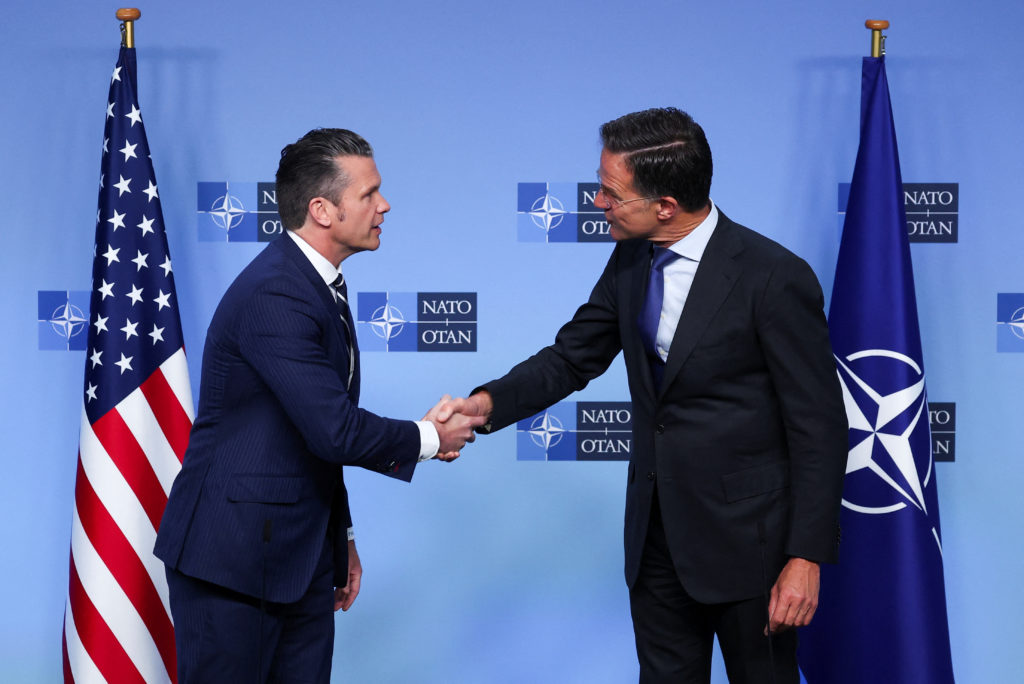

BRUSSELS (AP) — Most U.S. allies at NATO endorse President Donald Trump’s demand that they invest 5% of gross domestic product on their defense needs and are ready to ramp up security spending even more, NATO Secretary-General Mark Rutte said Thursday.
“There’s broad support,” Rutte told reporters after chairing a meeting of NATO defense ministers at the alliance’s Brussels headquarters. “We are really close,” he said, and added that he has “total confidence that we will get there” by the next NATO summit in three weeks.
WATCH: In Merz meeting, Trump says it might be better to let Ukraine and Russia ‘fight for a while’
European allies and Canada have already been investing heavily in their armed forces, as well as on weapons and ammunition, since Russia launched a full-scale invasion of Ukraine in 2022.
At the same time, some have balked at U.S. demands to invest 5% of GDP on defense — 3.5% on core military spending and 1.5% on the roads, bridges, airfields and sea ports needed to deploy armies more quickly.
Still struggling to meet the old goal
In 2023, as Russia’s full-scale war on Ukraine entered its second year, NATO leaders agreed to spend at least 2% of GDP on national defense budgets. So far, 22 of the 32 member countries have done so, and others still struggle to do so.
Trump and his NATO counterparts appear likely to endorse the new goal at a summit in The Hague on June 24-25. Trump insists that U.S. allies should spend at least 5% so America can focus on security priorities elsewhere, mostly in the Indo-Pacific and its own borders.
He has gained important leverage over the other NATO countries by casting doubt over whether the United States would defend allies that spend too little. At the same time, Trump has imposed tariffs on ally and foe alike, citing U.S. security concerns.
The new goal would involve a 1.5% increase over the current 2% goal for defense budgets. It means that all 32 countries would be investing the same percentage.
The United States spends by far more than any other ally in dollar terms.
But according to NATO’s most recent figures, it was estimated to have spent 3.19% of GDP in 2024, down from 3.68% a decade ago. It’s the only ally whose spending has dropped since 2014.
While the two new figures do add up to 5%, factoring in improvements to civilian infrastructure so that armies can deploy more quickly significantly changes the basis on which NATO traditionally calculates defense spending.
The seven-year time frame is also short by the alliance’s usual standards. The far more modest 2% target – set after Russia annexed Ukraine’s Crimean Peninsula in 2014 – was meant to be reached over a decade.
U.S. leadership at NATO
According to U.S. Defense Secretary Pete Hegseth, Trump has done nothing less than save NATO.
He told reporters that European…
Read More: NATO chief says alliance is ‘really close’ to accepting Trump’s 5% defense
