
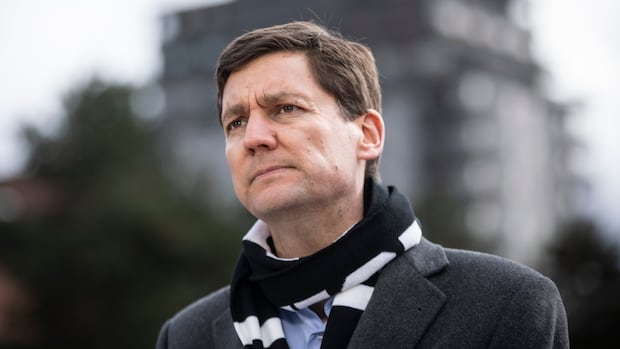

B.C. Premier David Eby has announced immediate countermeasures in response to incoming U.S. tariffs, saying the province will take action to protect B.C. workers and businesses.
Speaking at a news conference Saturday, Eby criticized the tariffs as a betrayal of the long-standing relationship between Canada and the U.S. He said the province would stand firm in the face of what he called an “unprecedented attack.”
As an initial response, Eby said he has directed the B.C. Liquor Distribution Branch to immediately stop purchasing American liquor from Republican-led “red states” and remove the top-selling brands from public liquor store shelves.
Eby had previously pushed for retaliatory tariffs and export bans if the tariffs went through, including an import ban on U.S. alcohol.

Premier David Eby announced immediate countermeasures to U.S. tariffs on Saturday, including banning “red-state” American liquor from public stores. He says the province will also fast-track permits for local projects and expand trade beyond the U.S. to reduce reliance on its market.
He also directed the B.C. government and Crown corporations on Saturday to buy Canadian goods and services over American ones.
“The Americans are bigger, but if we don’t stand up for ourselves, they will just keep coming back for more,” he said.
This comes on the same day U.S. President Donald Trump signed executive orders confirming he will impose a 25 per cent tariff on most Canadian imports beginning Tuesday, with a 10 per cent tariff on Canadian energy products.
Massive concerns for B.C. economy
The long-promised measures could completely upend B.C.’s economy, with the premier previously saying the tariffs would hit harder than the 2008 financial crisis.
A government analysis released in January showed that the tariffs, if they lasted for the entirety of Trump’s term until 2028, would lead to the province losing about $69 billion.

A statement by the White House on Saturday says U.S. President Donald Trump has imposed tariffs on imports from Canada, Mexico and China. The tariff order on Canada is 25 per cent on all imports, and 10 per cent on oil and gas to ‘minimize rise in costs.’
Speaking to reporters on Saturday, Eby said he is particularly concerned about the impact of the tariffs on B.C.’s forestry sector, which is already struggling with mill closures and job losses. He warned the new trade barriers would not only hurt B.C. workers, but also drive up housing costs in the U.S.
“One out of every five to six lumber used in the U.S. comes from Canada, and it just got 25 per cent more expensive,” he said.
Brian Menzies, executive director of the Independent Wood Processors Association of B.C., said the tariffs would be a…
Read More: B.C. premier announces countermeasures against U.S. tariffs, including ban
