
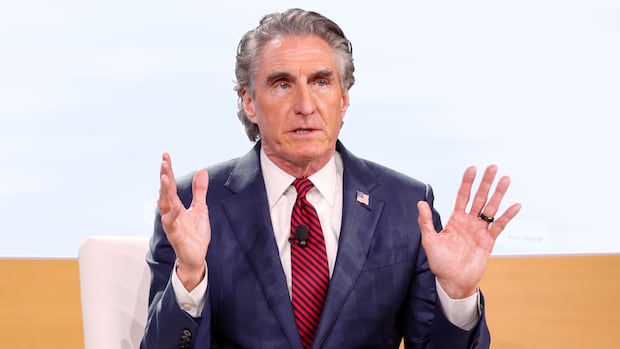

When U.S. Interior Secretary Doug Burgum travelled to Venezuela with oil and mining executives last month, he was trying to pitch them on the opportunity that exists in that country’s neglected oil and gas fields.
Then last week at a conference in Houston, he again tried to sell a room full of energy executives on the massive bounty of oil, natural gas and precious metals in the South American country.
Burgum — who plays a key role in the Trump administration — used the word “opportunity” three times when speaking about Venezuela at S&P Global’s recent CERAWeek energy conference.
“The resources there are quite amazing,” Burgum said.
U.S. Energy Secretary Chris Wright also appeared to be making the Venezuela sales pitch, speaking at the conference about how well “aligned” the interim government and the U.S. administration are when it comes to growing Venezuelan production.
But it’s unclear whether oil and gas executives are buying.
There is a plethora of challenges in Venezuela, from ongoing safety concerns to an unstable government, as well as the massive investment required to improve the infrastructure in its derelict oilfields.

U.S. President Donald Trump has been pressuring American oil and gas executives to invest in Venezuela’s energy sector, nearly three months after the toppling of former president Nicolás Maduro, as the country is said to have the largest crude oil reserves in the world.
In January, Trump held a White House meeting with the bosses of the biggest U.S. oil companies to ask for at least $100 billion US in investment to grow Venezuelan oil production to help lower U.S. energy prices.
Once a major producer, Venezuela only pumped about 900,000 barrels per day out of the ground last year, following many years of declining investment because of sanctions and failed government policies.
At its peak in 1970, Venezuela produced 3.7 million barrels per day.
According to Rystad Energy, Venezuela requires approximately $183 billion US in capital investment between 2026 and 2040 to restore oil production to three million barrels per day.

Venezuela sits on one of the largest oil deposits in the world – but not all oil is created equal. CBC’s Johanna Wagstaffe explains how millions of years of buried seabeds and oil-eating bacteria turned that reserve into some of the heaviest, hardest-to-extract crude on the planet.
The U.S. involvement has yet to result in a turning point in the country’s energy sector, said Luis A. Pacheco, a visiting fellow at the Baker Institute in Texas and a former Venezuela energy executive.
The actions of the Trump administration did “trigger a large expectation that has not been fulfilled as of today,” Pacheo said. “We’re not as close as we would like.”
Limited interest to invest
Some companies with…
Read More: Trump administration launches new bid to attract U.S. oil companies to
