


The Trump administration on Thursday imposed new tariffs on branded drugs from pharmaceutical companies that have not struck deals with the president to lower their U.S. drug prices – a long-awaited move that will likely only affect a small portion of drugmakers.
“We need to make sure that our drug supply is protected, secure and domestic,” a senior administration official, who declined to be named, told reporters on Thursday. “That is what we’re doing.”
Patented medications and their active ingredients face a 100% tariff under the plan, but there are pathways for drugmakers to reduce or avoid the levies, the official said.
The administration will impose a 20% tariff on companies that plan to onshore production, which would increase to 100% four years from now. Drugmakers that have fully executed drug pricing deals or are currently negotiating with the Health and Human Services department and are building manufacturing domestically would be exempt from the tariffs. New domestic plants must be completed by January 2029 to qualify, the official said.
Larger drugmakers have 120 days before the 100% tariff rate goes into effect, the official said, but the administration expects more companies to announce reshoring plans before then. Smaller drugmakers, which rely on contract manufacturers, have 180 days before that rate hits.
Meanwhile, some countries that have struck larger trade deals with the U.S. will face different pharmaceutical levies, with a 15% rate in the European Union, Japan, Korea and Switzerland. The U.K. will face a 10% tariff, in part because its government has raised the price of what it will pay for pharmaceuticals, the official said.
“Those countries, the production can stay in those countries because they’ve made a bigger trade deal with America,” the official said.
The plan represents another shift in Trump’s aggressive trade strategy, more than a month after the Supreme Court struck down the global levies he imposed in 2025, which excluded the pharmaceutical industry. The sector-specific tariffs follow a Commerce Department investigation that determined certain pharmaceutical imports pose a national security risk to the United States.
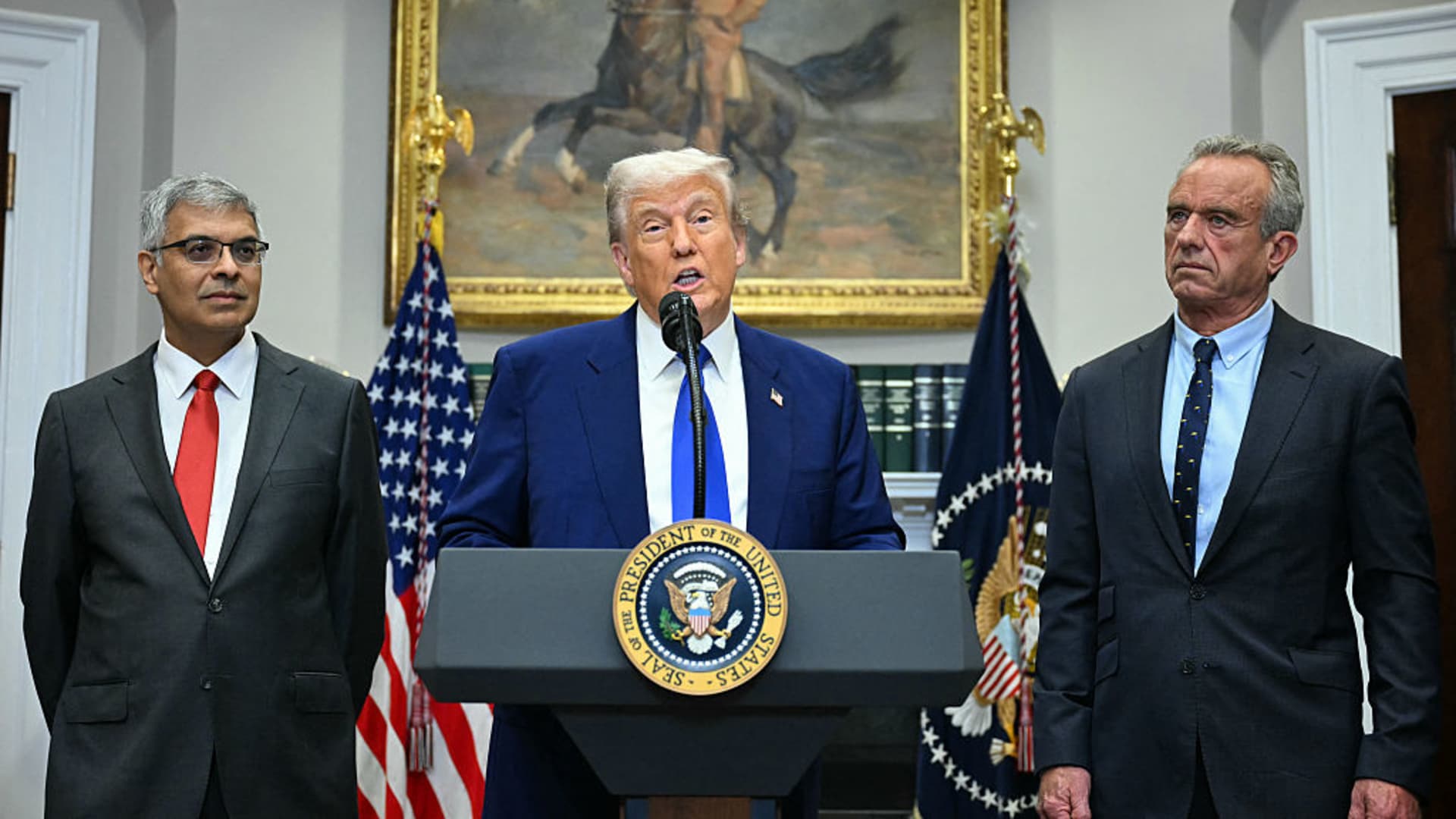
US President Donald Trump (C), alongside Secretary of Health and Human Services Robert F. Kennedy Jr. (R) and National Institute of Health (NIH) Director Jayanta Bhattacharya (L), speaks during a news conference about prescription drug prices, in the Roosevelt Room of the White House on May 12, 2025, in Washington, DC.
Jim Watson | Afp | Getty Images
Since November, more than a dozen major drugmakers, including Eli Lilly, Pfizer and Novo Nordisk, have inked deals with Trump to lower the prices of new and existing medicines. Those agreements are part of the president’s “most favored nation” policy, which ties U.S. drug prices to cheaper ones abroad, and exempted the companies from tariffs for three years.
The Trump administration official said 13 companies have already signed a drug pricing…
Read More: Trump prepares pharmaceutical tariffs of up to 100%
