
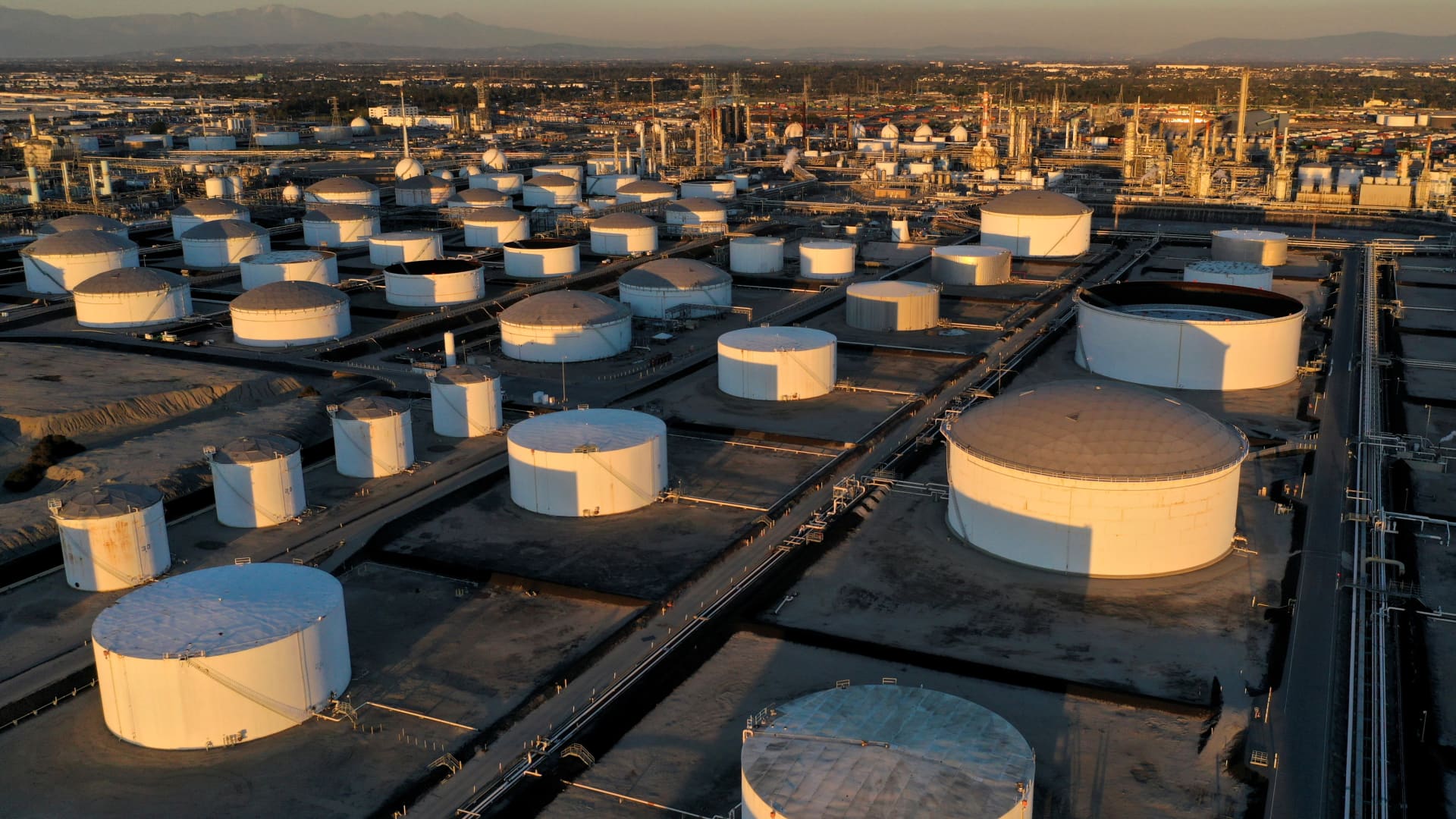

Smoke emanates from smokestacks from an oil refinery in Linden, New Jersey, on March 18, 2026.
Kena Betancur | AFP | Getty Images
Brent oil prices are on pace for the biggest monthly surge on record, as the Iran war has entered its fifth week with President Donald Trump threatening to destroy the Islamic Republic’s oil wells.
International benchmark Brent crude futures with May delivery rose 0.19%, or 21 cents, to close at $112.78 per barrel. Brent has soared about 55% in March, a record for the contract dating back to its inception in 1988. The previous monthly record was a 46% gain in September 1990 during the first Gulf War.
U.S. West Texas Intermediate futures with May delivery advanced 3.25%, or $3.24, to settle at $102.88. U.S. crude oil has also gained about 53% in March and is on pace for its best month since May 2020. Monday also marked WTI’s first settle above $100 since July 2022.
Trump on Monday warned Iran that the U.S. would destroy its oil wells, power plants, and Kharg Island unless the Strait of Hormuz was reopened.
In an interview with the Financial Times on Sunday, the U.S. president said his preferred option in Iran would be to “take the oil,” likening it to U.S. actions in Venezuela where Washington effectively gained control over the country’s oil sector after the capture of its leader Nicolás Maduro.
His remarks come as the conflict between U.S.-Israel and Iran has entered its fifth week, with attacks spreading across the region, heightening risks to energy infrastructure and driving a sharp rally in crude prices.

Oil prices since the start of the year
Yemen’s Houthis said Saturday they had launched missiles at Israel, marking their first direct involvement in the U.S.- Israel war against Iran.
In a post on X, Houthi spokesperson Yahya Saree said the group fired a barrage of ballistic missiles at what it called sensitive Israeli military targets, in support of Iran and Hezbollah forces in Lebanon.
The attack marks a further escalation in the conflict, which began with U.S. and Israeli strikes on Iran on Feb. 28.
Michael Haigh, global head of fixed income and commodities research at Societe Generale, said the potential for further disruption through the Bab el-Mandeb Strait, a key shipping channel linking the Gulf of Aden to the Red Sea, could push prices even higher.
“We’re talking between four and five million barrels per day going through there,” Haigh told CNBC’s “Squawk Box Europe” on Monday, referring to the Bab el-Mandeb Strait.
“Moving into April now, we’re going to see lots of adjustments going on but if we have another four million barrels taken out of the Red Sea, on top of what we already have, then this leg’s oil price is much, much higher,” he added.
In a note published earlier in the month, analysts at Societe Generale said prolonged supply disruption in the Middle East could push prices as high as $150 per barrel in April.
Analysts have told CNBC that the Houthis could attempt to…
Read More: Brent heads for record monthly gain on Iran war
