
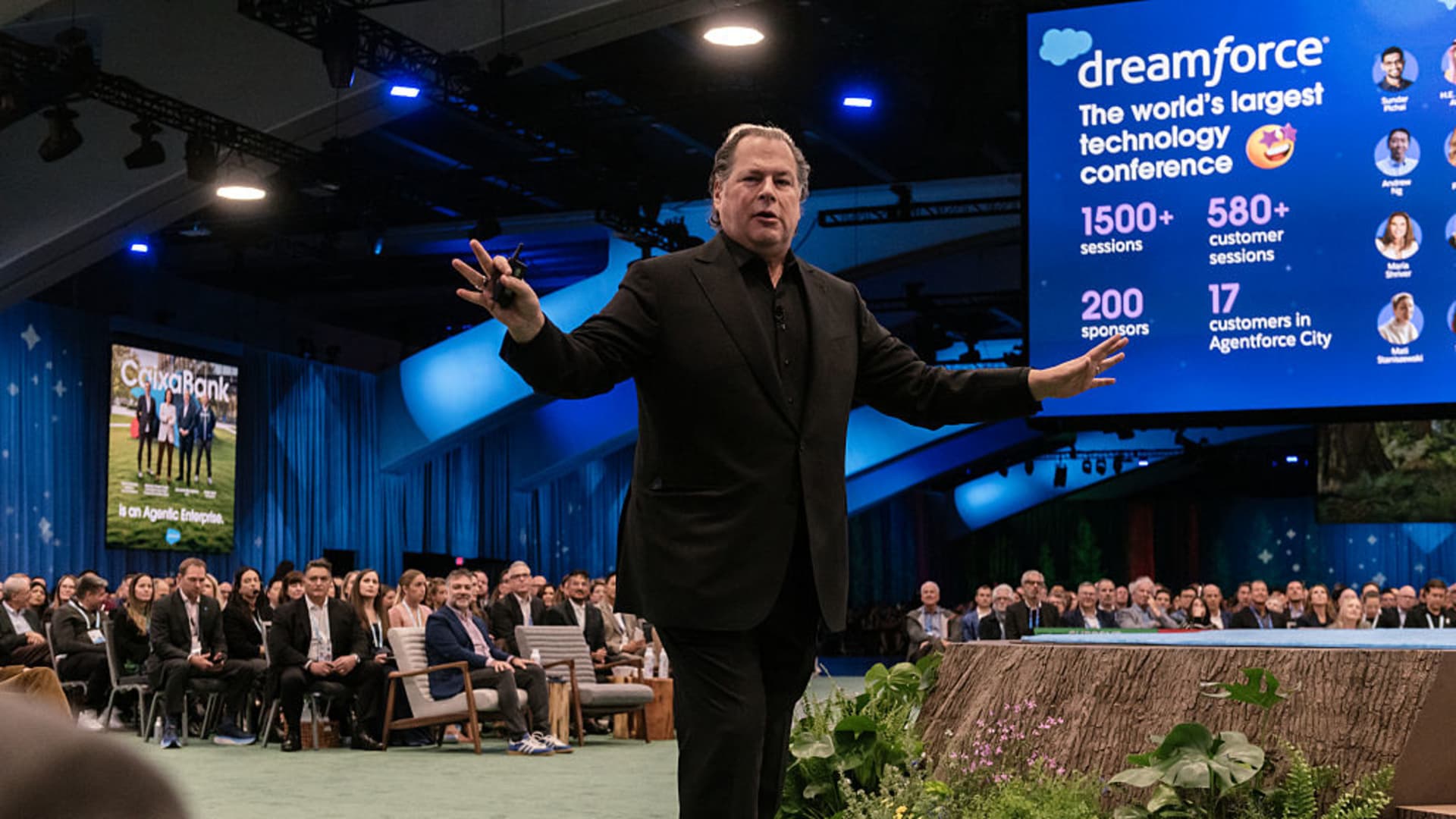

Marc Benioff, chief executive officer of Salesforce Inc., speaks during the 2025 Dreamforce conference in San Francisco, California, US, on Tuesday, Oct. 14, 2025.
Michael Short | Bloomberg | Getty Images
Salesforce announced this week that it executed the first steps in its debt-fueled $25 billion accelerated stock buyback plan. That’s half of the bigger $50 billion repurchase authorization approved in February.
Raising debt to repurchase stock is a move that deserves scrutiny.
After all, equity comes with neither the financial obligations nor the consequences of issuing debt. If a company misses a stock dividend payment, it doesn’t look good, and the stock will get hit. However, there are no legal consequences or claims to be filed. If a company defaults on debt, it will face legal issues and claims from bondholders.
We know why Salesforce wants to repurchase stock — management believes that last month’s brutal sell-off on AI disruption fears has made the share price attractive — because, as CEO Marc Benioff said in Monday’s press release: “We are so confident in the future of Salesforce.” (Salesforce insiders are also buying. Board member and Williams-Sonoma CEO Laura Alber purchased about $500,000 worth of Salesforce stock on Thursday, and David Kirk, also a director and former chief scientist at Nvidia, picked up roughly $500,000 worth of Salesforce stock on Wednesday.)
So, why is Salesforce issuing debt to buy back stock? Part of it may be that Benioff and company want to conserve cash. But mainly, it comes down to the cost of equity versus the cost of debt. CNBC Investing Club Reporter Paulina Likos and I actually touched on this concept briefly in a recent video about discounted cash flow valuation modeling. While the video was more focused on terminal value, we did cover the concept of a discounted rate, or the required rate of return an investor demands for investing in a given security. We noted that individual investors can and should use whatever rate they deem appropriate for the risk they are considering.
‘Shark Tank’ analogy on cost of capital
This stuff can be pretty complicated. In an oversimplified “Shark Tank” analogy, imagine you are starting a business. You need to figure out how to fund it. You can either give the sharks a percentage of your business (equity) or take a bank loan (which comes with the financial obligation to repay the principal plus interest). That decision is predicated on the cost of each — the interest rate on the loan (cost of debt) versus what you think that equity stake can generate (because you’re giving up the equity, this is your “cost of equity”). The ultimate goal, whichever route you go, is to fund your business with the lowest possible overall cost of capital.
For companies on Wall Street, however, the discount rate is often their own “weighted average cost of capital,” or WACC. The WACC is the weighted average of the cost of debt and equity required to fund the company.
Weighted average cost…
Read More: Salesforce issues $25 billion in debt to buy back stock. Should we be
