

The International Energy Agency’s executive director has called hydropower a “forgotten giant,” and has urged governments to do more to remember it. U.S. President Donald Trump has said hydropower is “fantastic,” a sharp contrast to his disdain for wind and solar.
But federal energy data shows that U.S. hydropower output has been nearly flat while other sources are growing.
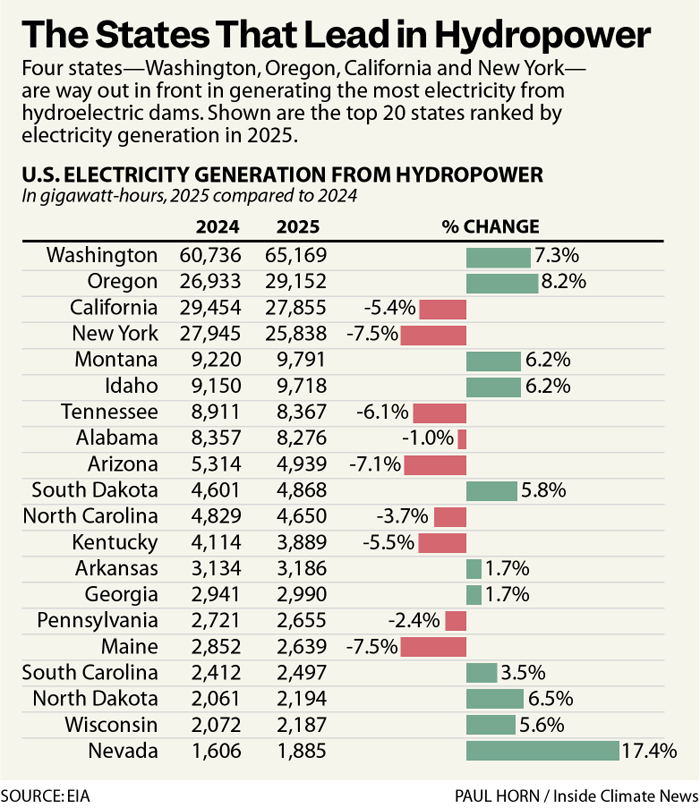
Last year, electricity generation from hydroelectric dams was up 1.7 percent from the prior year, according to the Energy Information Administration. The plants use the force of water to spin turbines and produce electricity.
Hydropower was long the country’s leading source of renewable energy, but it was passed in 2019 by wind and in 2025 by utility-scale solar. It’s still significant, though, with 5.6 percent of U.S. electricity generation. It’s the top electricity source in Washington state and Oregon and an important part of the mix in many other states.
Most U.S. hydroelectric dams are more than 50 years old and some are more than a century old. The last time more than 1,000 megawatts of new hydropower capacity went online in a year was in 1985.
Most recent U.S. projects are small, such as the 1-megawatt Waterman Turnout Hydroelectric Station, which went online in 2024 in San Bernardino County, California.
I spoke with Malcolm Woolf, president and CEO of the National Hydropower Association, to get an insider’s view of this power source. He and his members—which include utilities and equipment makers—are meeting this week in Washington, D.C., at their annual convention.
The association is lobbying the federal government to streamline the process to renew expiring licenses for old hydropower plants and to expand loan guarantees and other aid for new ones.
“Hydropower has never been more important on the grid,” he said.
Woolf previously worked for Advanced Energy United, a trade group for clean energy companies, and before that was head of the Maryland Energy Administration.
He said hydropower and pumped hydro energy storage are well-positioned to meet the rapid increase in electricity demand from data centers and the desire of many technology companies to use carbon-free electricity to power the centers.
In my view, hydropower is ripe for a U.S. renaissance, but it remains to be seen if utilities and investors will find this form of renewable energy compelling compared to other options.
The United States has 79,892 megawatts of hydropower capacity and 23,156 megawatts of pumped hydro storage capacity. For comparison, there are nearly 300,000 megawatts of combined cycle natural gas plants, the country’s leading electricity source.
Most of the projected growth is in pumped hydro storage, which is a form of long-duration energy storage. The plants pump water to a high elevation and store it in a reservoir for later use when the water is released and flows through a turbine to produce…
Read More: Can Hydropower Ride the Wave of the Energy Boom?
