
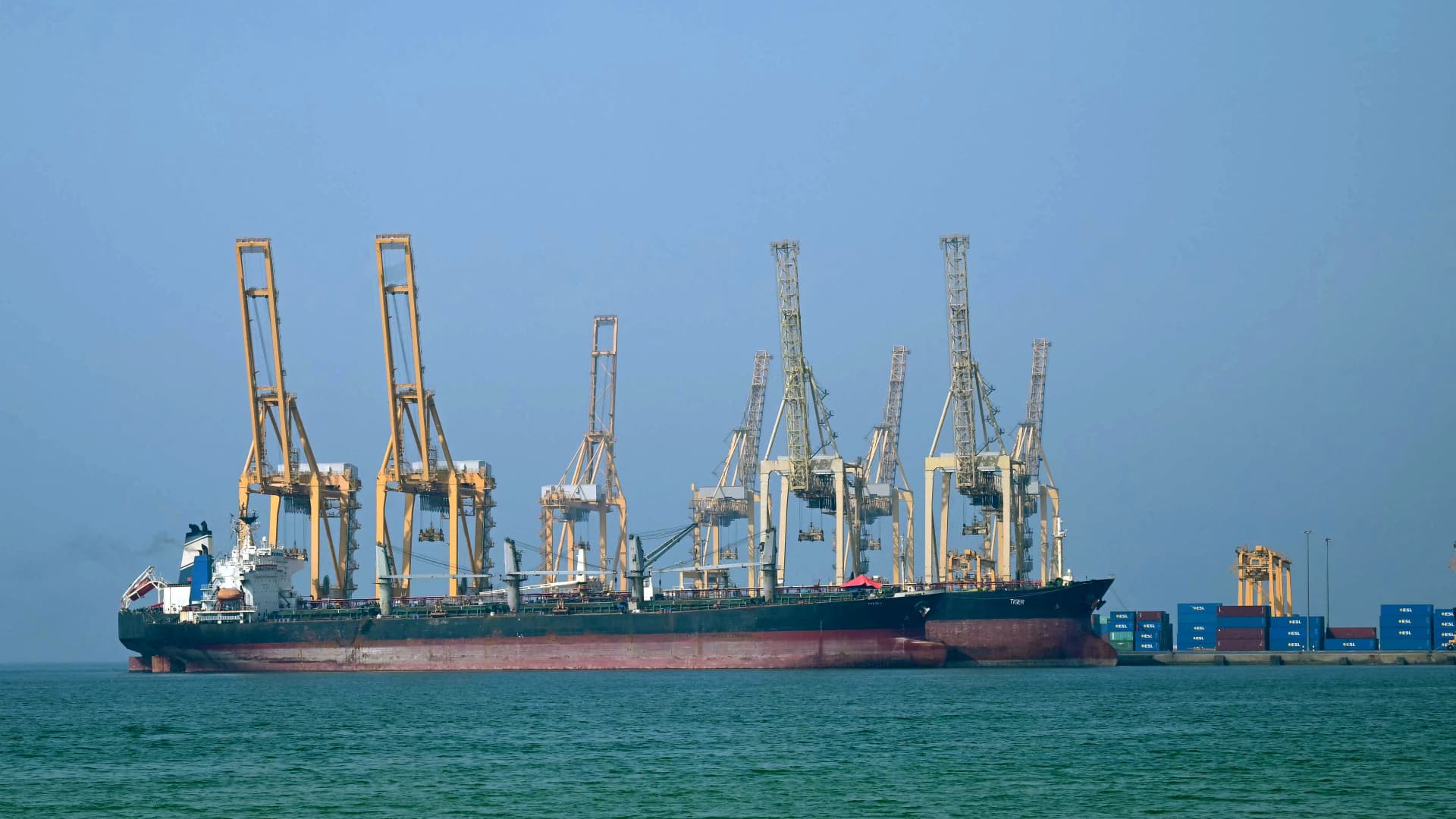

Tankers are seen at the Khor Fakkan Container Terminal, the only natural deep-sea port in the region and one of the major container ports in the Sharjah Emirate, along the Strait of Hormuz, a waterway through which one-fifth of global oil output passes on June 23, 2025.
Giuseppe Cacace | AFP | Getty Images
Oil markets are bracing for a possible supply shock after U.S. strikes on Iran over the weekend reignited fears that flows through the Strait of Hormuz could be disrupted.
While analysts expect an immediate “knee-jerk” reaction to oil prices when trading resumes in New York on Sunday evening, the bigger question is whether tensions could escalate into a sustained interruption of Gulf exports.
“At this point, it seems we are looking at a full-scale military conflict between the U.S. and Iran, which would be unprecedented and the trajectory impossible to assess,” said Vandana Hari, CEO of energy research firm Vanda Insights.
“If it carries on for days with Iran and its proxies retaliating to the fullest extent, we are looking at the worst-case scenarios for oil, including a major disruption of oil flows through the Middle East,” Hari told CNBC. This is unless the U.S. is able to pre-emptively disarm the Iranian navy and military, as well as ensure tanker traffic through the Strait of Hormuz continues to flow normally.
With tensions escalating, attention has shifted back to the Strait of Hormuz, where any disruption would have immediate and outsized consequences for global oil and LNG flows.

Oil prices year-on-year
Positioned between Oman and Iran, the strait serves as a critical transit route – and potential chokepoint – for global crude, with about 13 million barrels per day moving through it in 2025, equal to approximately 31% of all seaborne oil flows, Kpler data showed.
It links major Gulf producers including Saudi Arabia, Iran, Iraq and the United Arab Emirates to the Gulf of Oman and the Arabian Sea.
Reuters reported on Saturday that an official with the European Union’s naval mission, Aspides, said commercial vessels had received VHF radio messages from Iran’s Revolutionary Guards warning that “no ship is allowed to pass the Strait of Hormuz.”
The official was quoted as saying that Tehran had not formally confirmed any directive to close the waterway.
Early indications are of a broader scale attack on Iran, with counterattacks which could escalate to draw in multiple Gulf countries.
Reuters noted that Iran has repeatedly threatened over the years to block the narrow passage in response to attacks against the Islamic Republic.
Iran has in the past repeatedly threatened to block the narrow passage in response to attacks against the Islamic Republic.
Bob McNally, president of Rapidan Energy Group, who had advised clients for weeks that conflict was a 75% probability, called it “a very serious development” for the world’s oil and gas markets given their…
Read More: Experts weigh potential scenarios for oil if Strait of Hormuz closes
