
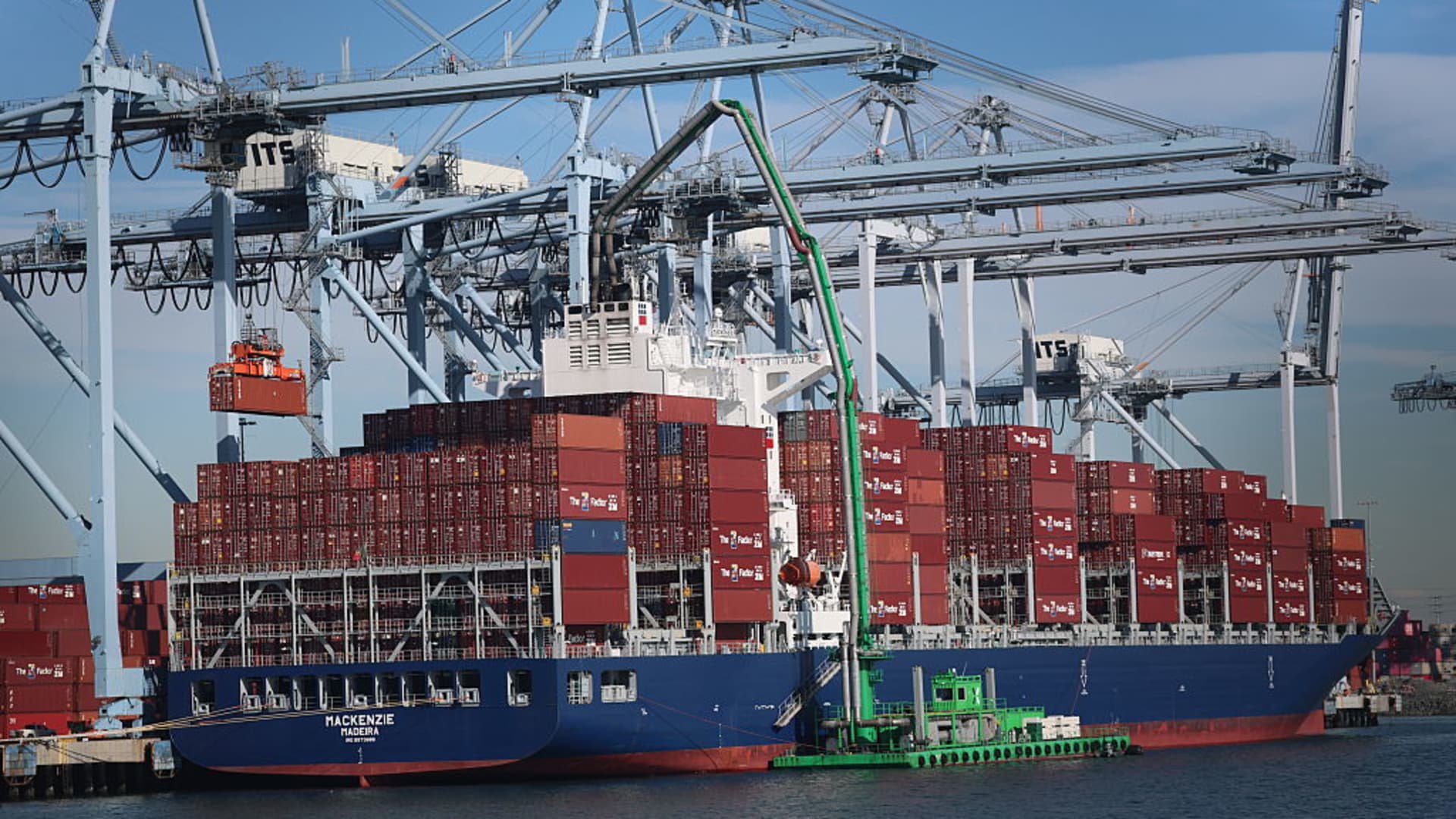

Cranes unload shipping containers from a ship at the Port of Long Beach Wednesday, Jan. 14, 2026.
Allen J. Schaben | Los Angeles Times | Getty Images
A record-breaking number of companies shipping products into the United States are coming up short on a federal government requirement to financially guarantee they can cover the import trade duties triggered by President Donald Trump‘s tariff policies.
And this is leading to a record amount of money paid to the U.S. to cover the shortfalls.
U.S. Customs data shared with CNBC shows that what are called customs bond “insufficiencies” reached a total of 27,479 in fiscal 2025, with the combined value soaring to almost $3.6 billion. It is the highest number of bond insufficiencies and the highest total value across insufficiencies ever recorded. In fact, it doubles the 2019 level when tariffs enacted by President Trump under Section 301 of the Trade Act of 1974 also fueled bond shortfalls.
“Bonds are the primary tool used by U.S. Customs and Border Protection to safeguard the revenue of the United States and ensure compliance with applicable laws and regulations,” said a U.S. Customs and Border Protection spokesperson.
Under U.S. Customs’ guidelines, the agency continuously reviews bond adequacy, and a bond is flagged as being insufficient when an importer’s duty/tax liability exceeds 100% of their current bond capacity. The record shortfall comes at a time of record tariff revenue for the U.S. government, with tariff collections surging in January to $30 billion and reaching a year-to-date total of $124 billion. That is up 304% from the same period in 2025.
“In totality, it makes sense that insufficiencies are more than double,” said Jennifer Diaz, attorney at Diaz Trade Law. “Many companies take it for granted that a $50,000 bond should be able to cover you for a one-year period,” she said. “But it might not. They are not utilizing set calculations, and don’t have anyone in their corner telling them that their bond obligation is higher.”
International trade experts told CNBC that with some tariffs increasing from 10%-25% or more for certain products, importers are facing customs bond amounts that now range from the minimum bond amount by regulation of $50,000 to as high as $450 million.
Importers buy customs bonds, also known as surety bonds, through specialized insurance companies known as surety companies. The bonds are issued approximately 30 days before imports arrive in the U.S. to ensure that Customs collects the requisite tariffs in the event an importer does not pay its obligation. The bonds are held for 314 days by Customs in accounts that bear no interest. During this time, duties that were paid can be reviewed and receive final government sign-off.
U.S. importers pay a premium to insure their bonds. The premium is typically 1% of the bond limit, with the price of the bonds covering 10% of the duties and taxes paid over a rolling 12-month period. If tariffs and taxes go up, the customs bond…
Read More: Tariff-linked Customs bond funding gap hits record $3.5 billion
