


Breaking with the United States, Canada has agreed to cut its 100% tariff on Chinese electric cars in return for lower tariffs on Canadian farm products, Prime Minister Mark Carney said Friday.
Carney made the announcement after two days of meetings with Chinese leaders. He said there would be an initial annual cap of 49,000 vehicles on Chinese EV exports to Canada, growing to about 70,000 over five years. China will reduce its total tariff on canola seeds, a major Canadian export, from 84% to about 15%, he told reporters.
Carney said China has become a more predictable partner to deal with than the U.S., the country’s neighbor and longtime ally.
“Our relationship has progressed in recent months with China. It is more predictable and you see results coming from that,” Carney said.
Carney hasn’t been able to reach a deal with President Trump to reduce some tariffs that are punishing some key sectors of the Canadian economy and Mr. Trump has previously talked about making Canada the 51st state.
The prime minister, speaking outside against the backdrop of a traditional pavilion and a frozen pond at a Beijing park, said meetings in China have been historic and productive.
Earlier Friday, he and Chinese leader Xi Jinping pledged to improve relations between their two nations after years of acrimony.
Xi told Carney in a meeting at the Great Hall of the People that he is willing to continue working to improve ties, noting that talks have been underway on restoring and restarting cooperation since the two held an initial meeting in October on the sidelines of a regional economic conference in South Korea.
“It can be said that our meeting last year opened a new chapter in turning China-Canada relations toward improvement,” China’s top leader said.
Xie Huanchi/Xinhua via Getty Images 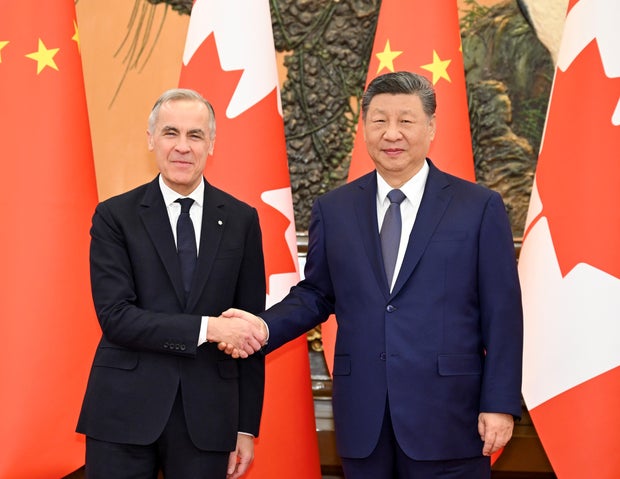
Carney looks to improve global governance
Carney, the first Canadian prime minister to visit China in eight years, told Xi that better relations would help improve a global governance system that he described as “under great strain.”
Later, he said at the news conference that the system may give way at least in part to country-to-country or regional agreements rather than the global ones that have underpinned economic growth in the post-World War II era.
“The question is: What gets built in that place? How much of a patchwork is it?” he said.
The new reality reflects in large part the so-called America-first approach of Mr. Trump. The tariffs he has imposed have hit both the Canadian and Chinese economies. Carney, who has met with several leading Chinese companies in Beijing, said ahead of his trip that his…
Read More: Canada agrees to cut tariff on Chinese electric vehicles in break with the
